Key Takeaways
Direct offshore hiring through OnlineJobs.ph or a freelance platform costs less per hour but puts recruiting, vetting, onboarding, managing, and replacing the EA entirely on you. A managed service costs more per month but handles those functions, delivers a pre-vetted placement, and covers replacement if the fit is not right. The right choice depends on one honest question: what is your time worth, and how much of it can you spend on sourcing and managing an offshore hire before the cost advantage disappears?
Direct hiring is cheaper on the rate card. That is a fact. A full-time offshore EA hired through OnlineJobs.ph costs $800 to $1,500 per month direct to the assistant. A managed service runs $1,200 to $2,000 per month. The gap looks clear until you price the operator’s time. This article works through both models specifically: what each one costs, what each one requires, and which one makes sense depending on your situation.
The decision you are actually making
If you have decided offshore EA support is the right direction, the next question is not whether to hire. It is how to hire. The two paths have meaningfully different cost structures, time investments, and risk profiles, and the cheaper option on paper is not always cheaper in practice. The question of hiring local vs virtual for small businesses is already behind you. This comparison starts one step later.
What this article is not
This is not a general offshore hiring guide. It is a direct comparison of two sourcing models for a buyer who has already resolved the offshore question and is now deciding how to execute it. The article covers what each model delivers and what it requires from the operator, nothing more.
Why the hourly rate comparison misses the point
Comparing OnlineJobs.ph at $5 to $10 per hour to a managed service at $1,200 to $2,000 per month looks like a straightforward cost difference. It is not. The hourly rate on a direct hire does not include the recruiting time, the vetting process, the onboarding investment, the ongoing management overhead, or the replacement cost if the first hire does not work out. The comparison that matters is total cost and total time, not rate card vs. rate card.
What you actually take on when you hire direct
Hiring direct through OnlineJobs.ph, Upwork, or a freelance platform is a genuine option, but it is a hiring process, not a purchase. You are the recruiter, the screener, the interviewer, the reference checker, the offer-maker, the onboarding manager, the performance reviewer, and the replacement sourcer if it does not work out.
The recruiting and vetting phase, what it takes
When hiring offshore direct, the founder runs the full recruitment cycle: writing the job description, posting to the platform, screening incoming applications, shortlisting, running skills tests, conducting interviews across time zones, checking references, and making an offer. A posting on OnlineJobs.ph commonly generates 50 to 200+ applications. For a founder without an HR background or a prior offshore hiring process, this takes 15 to 40 hours of calendar time over 3 to 6 weeks.
That time has a cost whether or not it appears in the budget. testing EA skills before committing covers what a proper skills assessment requires, and the assessment alone takes several hours to build and score if you are running it yourself for the first time.
The onboarding investment, what it looks like in practice
A direct hire arrives with no knowledge of your systems, preferences, processes, or clients. A 30-60-90 day onboarding structure is the minimum to get a direct hire to independent productivity. The operator writes the SOPs, documents the workflows, sets up access, runs the check-ins, and handles the corrections. An onboarding plan for a new EA is not complicated to build, but it takes 20 to 30 hours of the operator’s time across the first 60 days.
The managed service equivalent: the provider runs a documented onboarding process, the EA arrives with baseline training on common tools and workflows, and the operator’s contribution is direction-setting rather than process-building from scratch.
The ongoing management overhead, what does not disappear
After the hire is productive, the direct model means the operator is also the performance manager, the correction-giver, and the escalation point when anything goes sideways. In a sub-15-person firm with no HR function, this lands entirely on the founder. Estimate 2 to 4 hours per week in the first 90 days.
The managed service equivalent covers this layer. The provider’s account management handles performance issues, correction conversations, and escalations. The operator retains direction-setting and workflow review, not the management function underneath it.
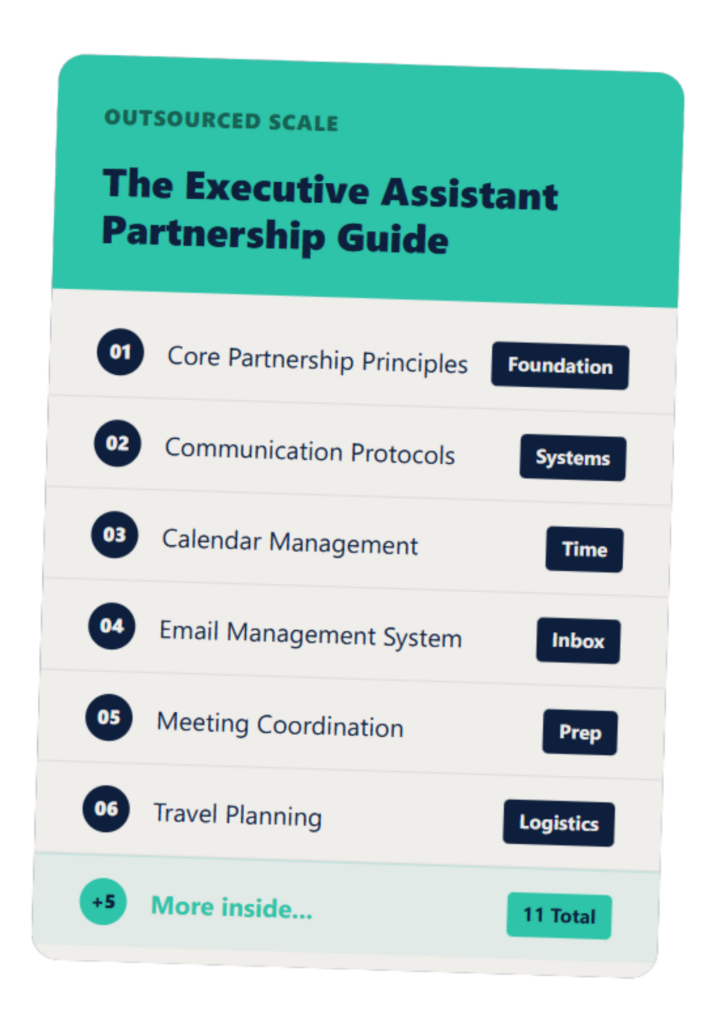
The Executive Assistant Guide
A customizable EA system that helps you and your assistant work smarter—not harder.
What the direct-hire risk looks like in practice
The mis-hire risk for direct offshore hiring is not hypothetical. Industry estimates put the bad-fit rate at 30 to 40%, meaning roughly 1 in 3 direct hires requires replacement within the first several months. The common first-time EA hire mistakes follow a consistent pattern, and none of them are unique to the operator who made them.
What replacement actually costs
A replacement cycle on a direct hire means the recruiting process restarts from the beginning: 15 to 40 hours of time, another 3 to 6 weeks on the calendar, and a productivity gap during the transition that the founder absorbs. SHRM’s 2024 data puts the average direct recruiting cost per hire at $4,700 to $7,600 in direct expenses alone. For a founder without HR infrastructure running their own search, the time cost typically exceeds that figure before the first day of onboarding.
A managed service replacement works differently. The operator files a replacement request. The provider sources, vets, and places a replacement. The operator does not restart a cold recruiting process.
The protection a replacement guarantee actually provides
A replacement guarantee does not guarantee a perfect match on the first placement. What it does is remove the replacement cycle from the operator’s plate. For a founder without time to run multiple recruitment cycles, that guarantee eliminates a real category of operational risk. The cost difference between models is partly a premium for that insurance.
What a managed service actually delivers
A managed offshore executive assistant service is not simply a sourced hire. It is a model in which the provider owns recruiting, vetting, initial training, placement, performance management, and replacement, and the operator pays a margin for that infrastructure.
What the operator still owns in a managed model
A managed service does not remove the operator from the relationship. The operator still sets direction, defines priorities, reviews output, and documents their own workflows for the EA to follow. What changes is the layer below that. The managed service handles sourcing, placement, and performance infrastructure. The operator works in the direction seat rather than the management seat.
Founders who expect to hand off everything to a managed service will be disappointed. Founders who want to hand off recruiting, HR, and replacement while retaining direction, that is what a managed model delivers.
Where the cost difference comes from
The managed service margin covers real costs: the provider’s recruiting and vetting operation, the training infrastructure, account management staffing, replacement guarantee administration, and the compliance overhead of employing offshore staff directly rather than as independent contractors. The margin is not padding. It is the cost of the infrastructure the operator would otherwise build and run themselves.
The cost comparison, what you are actually comparing
The comparison is not rate card vs. rate card. It is total cost including the operator’s time vs. total cost including the managed service margin.
Direct hire cost model
A full-time offshore EA in the Philippines hired direct costs $800 to $1,500 per month to the assistant. On top of that, the operator’s recruiting time runs 15 to 40 hours at their effective hourly rate. Onboarding adds another 20 to 30 hours over the first 60 days. Ongoing management overhead runs 2 to 4 hours per week in the first 90 days. The replacement risk factor rounds out the picture: a 30 to 40% probability of a replacement cycle within 6 months, which adds another 15 to 40 hours of recruiting time and a 30 to 60 day productivity gap.
Managed service cost model
A full-time managed offshore EA runs $1,200 to $2,000 per month. This covers a pre-vetted EA, documented onboarding support, account management, performance oversight, and replacement coverage. The operator’s time investment in sourcing and placement is close to zero. Direction-setting and workflow documentation remain with the operator. The offshore vs US-based EA cost comparison covers the broader context if you are also comparing against a domestic hire.
The break-even question
The monthly cost difference between a direct hire and a managed service is $400 to $600, roughly $5,000 to $7,000 per year. If the operator spends 20 hours recruiting and 20 hours onboarding a direct hire and values their time at $100 per hour, that is $4,000 in time cost before the EA starts productive work. One replacement cycle erases the annual cost difference entirely. The break-even calculation is not complicated. It requires the operator to price their own time honestly.
Which model fits your situation
The honest answer is that direct hiring makes sense for operators with time to run a thorough recruitment process, prior offshore hiring experience, and the ability to absorb a replacement cycle if needed. For founders of sub-15-person service businesses without HR staff, the direct hire cost advantage tends to disappear when time is priced at its actual opportunity cost.
When direct hiring is the right call
- Prior offshore hiring experience and a documented vetting process you can run without building it from scratch.
- Someone in-house who can run the recruiting process rather than the founder doing it personally.
- Building an offshore team with multiple placements, which amortizes the recruiting investment across more roles.
- You have the time and bandwidth to absorb a replacement cycle if the first placement does not work out.
The best way to hire an offshore executive assistant covers the direct-hire path in detail for operators who have evaluated the trade-offs and want to run their own process.
When a managed service is the right call
- This is your first offshore hire and you do not have a vetting process or skills assessment built.
- You are a founder-operator with no HR function and recruiting would pull you away from client work for 3 to 6 weeks.
- Your time has a high opportunity cost and the cost difference between models is smaller than the time cost of sourcing direct.
- You have been burned by a direct hire before and want the replacement guarantee as risk mitigation rather than absorbing another full cycle.
The version of this decision most founders get wrong
The comparison almost always starts with the monthly rate and ends there. That is the wrong stopping point. The right question is how much of your time the arrangement requires and what that time costs your business.
Direct hire is lower cost per hour and higher cost in operator time. A managed service flips that: higher cost per month, lower cost in operator time. Founders of service businesses with no HR infrastructure typically find the managed service cheaper in practice once time is priced honestly. Prior offshore experience changes the calculation. If you have a documented process and someone else running the search, the direct model may well come out ahead.
The math is not complicated. The mistake is skipping the time cost side of the equation and treating the rate card difference as the whole comparison. If you have done the math and a managed service looks like it fits your situation, the fastest way to confirm it is a short conversation, not a demo, not a package presentation. We cover what your workflow actually needs, what the cost structure looks like for your firm, and whether the model makes sense. You can talk through your workflow in 20 minutes and leave with a clear answer either way.
FAQs About Managed EA Service
Q: Is it cheaper to hire an offshore EA directly or through a managed service?
Direct hiring typically costs $800 to $1,500 per month direct to the EA; a managed service runs $1,200 to $2,000 per month. For founders without an HR function, the total cost of direct hiring often exceeds the managed service rate once recruiting time, onboarding time, and replacement risk are priced honestly.
Q: What is the bad hire rate for direct offshore hires?
Industry estimates put the bad-fit rate at 30 to 40%, meaning roughly 1 in 3 direct hires requires replacement within the first several months. A managed service replacement is handled by the provider with no cold recruiting required from the operator.
Q: What does a managed offshore EA service actually include that a direct hire does not?
A managed service covers recruiting, vetting, initial training infrastructure, placement, performance management, account management, and replacement administration. The operator retains direction-setting and workflow review; everything below that layer stays with the provider.
Q: How long does it take to hire an offshore EA directly?
A direct offshore hire typically takes 3 to 6 weeks from posting to placement, not counting onboarding. Founders report spending 15 to 40 hours on the process. A managed service placement typically takes 1 to 2 weeks with the provider handling sourcing and vetting.
Q: When does direct offshore hiring make sense?
Direct hiring fits when you have prior offshore hiring experience and a documented vetting process, someone in-house to run recruiting rather than the founder, or you are building an offshore team where the recruiting investment is shared across multiple placements. For a first-time offshore hire at a sub-15-person firm, the direct model typically requires more founder time than the cost savings justify.
Q: How do I decide between OnlineJobs.ph and a managed service for my first EA hire?
The honest decision variable is your time cost. If recruiting takes 20 hours and your time is worth $100 per hour, that is $2,000 in time cost not visible on the rate card. The monthly cost difference between models is $400 to $600. One replacement cycle erases the annual cost advantage of direct hiring entirely.