

Key Takeaways
- Small firm owners become default operations managers gradually, as each new client, hire, or tool adds coordination overhead that routes to the owner by default.
- The operator trap is self-reinforcing: owners are too absorbed in running operations to document processes, and too undocumented to delegate safely.
- An owner billing $150 per hour who spends 10 weekly hours on operations absorbs $78,000 per year in professional capacity occupied by coordination tasks.
- Delegating a task clears your plate temporarily; delegating ownership of a workflow removes you from the bottleneck permanently.
- The first step out is a one-week task audit that identifies recurring processes requiring no professional credential, which becomes the starting delegation inventory.
Small service firm owners do not set out to become their own operations manager. It happens because every new client, new tool, or new team member adds complexity that defaults to the owner when there is no one else to catch it. The trap is structural and so is the exit. This article explains how it forms, why it persists, and what the first step out actually looks like.
How small firm owners become their own default operations manager
The trap does not form all at once. It builds one small delegation failure at a time. The owner handles something because it is faster to do it themselves, and then it becomes permanent.
Stage 1: the solo founder doing everything by necessity
In the early days, the owner doing everything makes sense. There is no one else. Client work, scheduling, invoicing, follow-up, and tool management all sit with one person because the firm is one person. This stage is not a problem. It is just the starting condition.
The problem is what gets carried forward from it.
Stage 2: first hires arrive and the owner becomes the hub
When the first staff members join, something shifts. The owner becomes the person who knows how everything works, because they built it. Questions route to them. Approvals route to them. Decisions that could be made by someone else wait for their input because there is no documented process that says otherwise.
The owner is now doing two jobs: their professional work and the coordination layer that keeps everyone else moving. Neither role is fully acknowledged. Both consume hours.
Stage 3: every workflow routes through the owner by default
By the time a CPA, HR, or payroll firm reaches five to fifteen people, the routing problem is entrenched. New clients create new coordination tasks that land on the owner, new hires create onboarding overhead that the owner manages. New tools require decisions that only the owner feels equipped to make. The firm is growing, but the owner’s workload is growing faster.
At this stage, the bottleneck is not a person. It is a missing operational layer.
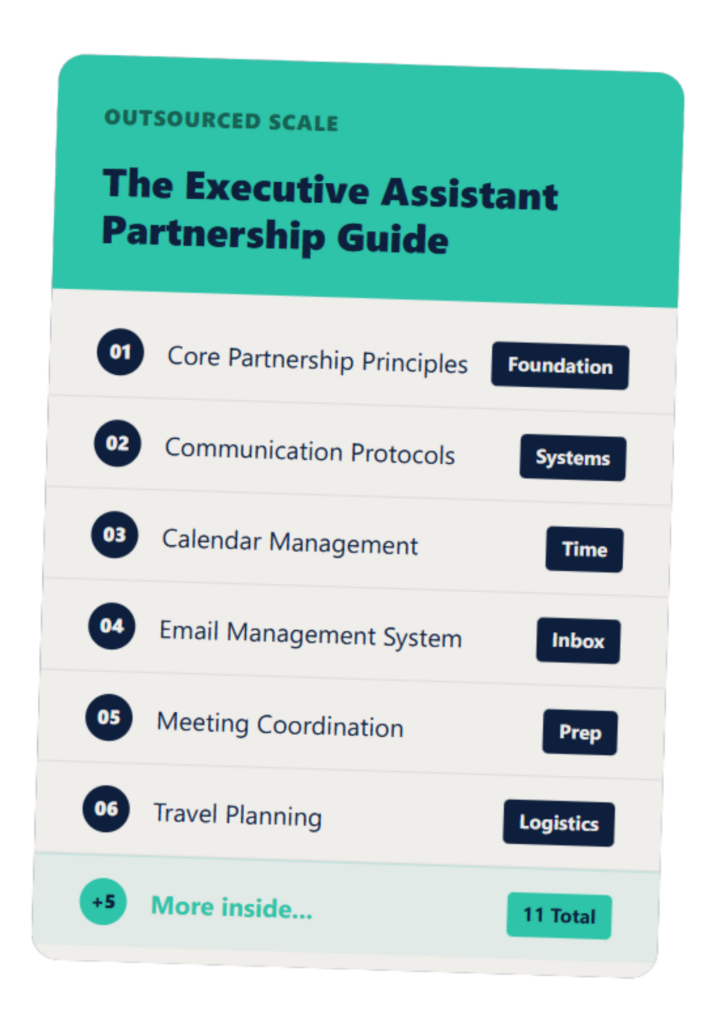
The Executive Assistant Guide
A customizable EA system that helps you and your assistant work smarter—not harder.
Why the operator trap is harder to escape than it looks
Firm owners can see they are the bottleneck. What they cannot see is how to stop being the bottleneck without things breaking.
The “faster to do it myself” calculation that keeps the owner stuck
Every time an owner considers delegating something, they run a quick mental calculation: how long will it take to explain this versus just doing it? For tasks without a documented process, the answer almost always favors doing it themselves. The problem is that calculation compounds. Every task absorbed to save five minutes of explanation adds five minutes permanently to the owner’s weekly load.
The calculation is not wrong in isolation. It is wrong as a policy.
Why delegation feels risky when there are no documented processes
Delegation requires a handoff. A handoff requires a process. When processes exist only in the owner’s head, delegation feels like a gamble. The owner cannot hand off what they have not articulated, and articulating it takes time they do not have because they are running operations.
This is the loop that makes the trap self-reinforcing. The owner is absorbed in operating to document, and too undocumented to delegate.
The identity layer: professionals who define themselves by their work struggle to hand it off
There is a softer version of this problem that does not get named often enough. CPA, HR, and payroll firm owners built their businesses on professional expertise. Their identity is tied to doing the work well. Handing off client coordination, report formatting, or onboarding logistics can feel like a reduction in quality control, even when the tasks do not require their expertise at all. The result is an owner who holds on to work that could move, not because delegation is impossible, but because letting go feels like a risk they have not been convinced is worth taking.
What the operator trap costs a professional service firm
Being the operations manager does not just consume time. It caps the firm’s growth at what the owner can personally absorb.
The growth ceiling: why firms plateau at the owner’s capacity
A firm where every workflow routes through the owner can only grow as fast as the owner can process throughput. New clients mean more coordination. More staff means more management overhead. More revenue means more complexity, all of it landing in the same place. The ceiling is not the market or the team. It is the owner’s available hours, and that number does not scale.
The key-person risk: what happens when the owner takes a day off
When an owner cannot take a day off without a backlog forming, the firm has a structural problem. This is not a productivity issue. It is a risk issue. A firm dependent on one person’s daily availability is fragile in ways that compound over time, from vacation coverage to health to the ability to focus on a new client relationship without the existing ones suffering.
Reviewing whether hiring an EA is worth it is often where this conversation becomes concrete: not as a productivity exercise, but as a way to assess how much of the owner’s load is operational rather than professional.
The burnout math: how many hours of operations work per week is unsustainable
An owner billing at $150/hr who spends 10 hours per week on operational tasks is absorbing $1,500 per week in capacity that cannot go toward client work or firm development. Over a year, that is $78,000 in professional capacity occupied by coordination, scheduling, formatting, and follow-up. The number is not the point. The pattern is.
The first step out of the operator trap
The exit does not start with a restructure. It starts with identifying which recurring workflows can be owned by someone else, completely, not just assisted.
The delegation audit: which recurring tasks do not require your expertise
Spend one week logging every task you complete. Flag anything that follows a repeatable process and does not require your professional credential to execute. That list is your starting delegation inventory. Most firm owners who complete this exercise find the list is longer than they expected. The US Chamber of Commerce reports that 67% of small business owners who delegated to a virtual assistant freed up meaningful time to focus on growing their business rather than running it.
The full breakdown of tasks to delegate to an EA covers the complete transfer list across scheduling, communications, and operations for service firms.
The difference between delegating a task and delegating ownership of a workflow
Delegating a task means handing off a one-time action. Delegating a workflow means transferring ownership of a recurring process so it runs without your involvement from that point on. The second removes you from the bottleneck. The first just clears your plate temporarily.
Understanding first-time EA hire mistakes to avoid matters here because the most common mistake is treating an EA as a task handler rather than a workflow owner. The guide on how to manage an EA covers how to structure ownership and feedback once the handoff is made.
What adding an operational layer looks like for a 5-15 person firm
For most CPA, HR, and payroll firms at this size, the first operational layer is a single role: an EA or operations coordinator who owns the recurring coordination and administrative workflows. This is not a full operations hire. It is a buffer between the owner and the tasks that consume daily capacity without requiring professional judgment.
The guides on building offshore teams that deliver and the offshore growth assistant blueprint cover how firms at this stage structure that layer without adding management overhead that recreates the original problem.
FAQs About Small Firm Owners Operations
Why do small firm owners end up doing so much operational work?
It is structural. When a firm grows without building an operational layer, every new client, task, or hire adds complexity that routes to the owner by default.
How do I know if I am the bottleneck in my own firm?
If work regularly waits for your input before moving forward, if team members ask questions that have been answered before, or if you cannot take a day off without things backing up, you are the operational bottleneck.
What is the difference between delegating tasks and delegating workflows?
Delegating a task means handing off a one-time action; delegating a workflow means transferring ownership of a recurring process so it runs without your involvement, which is what actually removes you from the bottleneck.
Can a small firm function without the owner managing operations?
Yes, and that is the goal. Most firms that get there use a dedicated operational role, often an EA or ops coordinator, as the first layer between the owner and day-to-day operations.
What is the first step to getting out of the operator trap?
Run a task audit for one week, list everything you do, and flag anything that follows a repeatable process and does not require your professional judgment. That list is your starting delegation inventory.
If you spent more than 3 hours this week on tasks that have a process behind them, that is the starting point. Book a 20-minute conversation and we will help you identify which workflows move first.