

Key Takeaways
In 2026, AI fluency for executive assistants means something specific: prompt writing and iteration, AI-assisted research with source verification, workflow automation setup in tools like Zapier or Make, document drafting and editing using AI, and quality control of AI outputs. The difference between an EA who knows the tool names and one who uses them inside documented workflows is testable, and this article covers how to test it. It also covers what to ask when a provider claims their EAs are AI-trained, because that claim can mean almost anything.
In 2026, five AI skill categories define what genuine remote executive assistant AI skills look like in practice: prompt writing and iteration, AI-assisted research and summarization with source verification, workflow automation setup, document drafting and editing using AI assistance, and output review and quality control. This article defines each category specifically, gives you a test task for each one, and covers how to evaluate what a provider means when they say their EAs are AI-trained.
Why AI fluency is now a baseline requirement, not a differentiator
A year ago, AI fluency in an EA candidate was a differentiator. In 2026, it is closer to a baseline expectation, not because every EA is AI-fluent, but because the ones who are not are taking two to three times longer to complete work that a fluent EA handles in a single tool call. The shift from bonus to baseline is already underway, and how CEOs are using AI offshore talent in 2026 covers how that is playing out across professional services firms right now.
For what to expect once you have an AI-fluent EA in place, what an AI-trained executive assistant can actually do covers the output side. This article covers the evaluation side.
What the adoption data actually shows
ASAP’s 2024 survey of nearly 4,000 North American administrative professionals found that only 26% reported using AI on the job. EAs who support executives were 42% more likely to use AI than other admin professionals, 27% versus 19%, but that still means nearly three in four EAs on the market are not using AI tools in their daily work. Requiring AI skills explicitly in a job description and testing for them in the hiring process is not overcautious. It is the only way to tell who actually has them.
The two EA profiles in the current market
There are two profiles in circulation right now. The first can tell you they use ChatGPT. The second can show you a prompt they have saved for a recurring task, describe how they check AI output before sending, and walk through a workflow they have set up in Zapier or Make. Both profiles will describe themselves as AI-fluent on a resume. The gap between them in daily output is real and measurable, and it is not visible from a resume screen alone.
The five AI skill categories to require, and what each looks like in practice
AI fluency for an EA is not one skill. It is five distinct competency areas, each of which maps to specific recurring tasks. The full executive assistant skills guide covers the complete skill baseline. This section focuses on the AI-specific layer that now belongs on top of it.
Prompt writing and iteration
A competent EA is not writing prompts for the first time during a task. They have a documented library of prompts for recurring work: email drafts, meeting summaries, research queries, status updates. When output is off-standard, they revise the prompt rather than revising the output by hand. The test: give the candidate a specific EA task (summarize this meeting transcript into three action items with assigned owners and due dates) and ask them to write a prompt for it. Then give them a sample output that is too vague and ask them to improve the prompt. An EA who can do this quickly and deliberately is applying prompt fluency. An EA who adds adjectives to the original prompt and calls it revised is not.
AI-assisted research and summarization with source verification
An EA using AI for research does not hand unverified output to the executive. They verify claims against primary sources, identify where the AI has hallucinated or overgeneralized, and present the result with citations attached. The test: give a candidate a research question with a factual dimension relevant to your work, ask them to produce a one-page summary using any tools they choose, and evaluate whether they cite sources, flag anything they could not confirm, and note where the AI output conflicted with the primary source. An EA who produces a clean AI summary without any source citations has not done verification. That is the output pattern to screen out.
Workflow automation setup
Not every EA needs to build complex automations from scratch, but a fluent EA in 2026 can set up a basic trigger-action workflow in Zapier or Make, modify an existing workflow when a step breaks, and explain what each step does and what the failure mode looks like. The test: ask the candidate to describe a workflow they have built or modified using Make, Zapier, or a similar tool. Ask them to name the trigger, the action, the condition under which the automation should not fire automatically, and what happens if the trigger does not fire. A vague answer about “automating some things” is not the same as being able to walk through a specific workflow they have built and maintained.
Document drafting and editing using AI
The competency here is using AI as a drafting tool without using it as a replacement for judgment. A skilled EA produces an AI first draft of a proposal, email, or status update, then edits it for accuracy, removes anything that does not match the executive’s voice, and flags anything that requires the executive’s input before it goes out. The test: give the candidate a scenario (draft a follow-up email after a client call where two action items were not resolved) and ask them to draft it using AI assistance. Evaluate whether the output is in a natural voice, whether it captures the open items accurately, and whether it contains any hedging language or hallucinated specifics the AI introduced. An EA who submits the raw AI draft without edits has not applied the skill.
Output review and quality control
This is the skill that separates EA-level AI use from naive use. A quality-control-fluent EA knows that every piece of AI output requires a review pass before it leaves their screen: accuracy, tone, hallucinated facts, and appropriateness for the specific recipient. The test: give the candidate an AI-generated email draft with two deliberate errors embedded, a wrong date and a factual claim that needs verification. Ask them to review it before it goes out. An EA who catches both errors and flags them is applying genuine quality control. An EA who sends it as written has not.
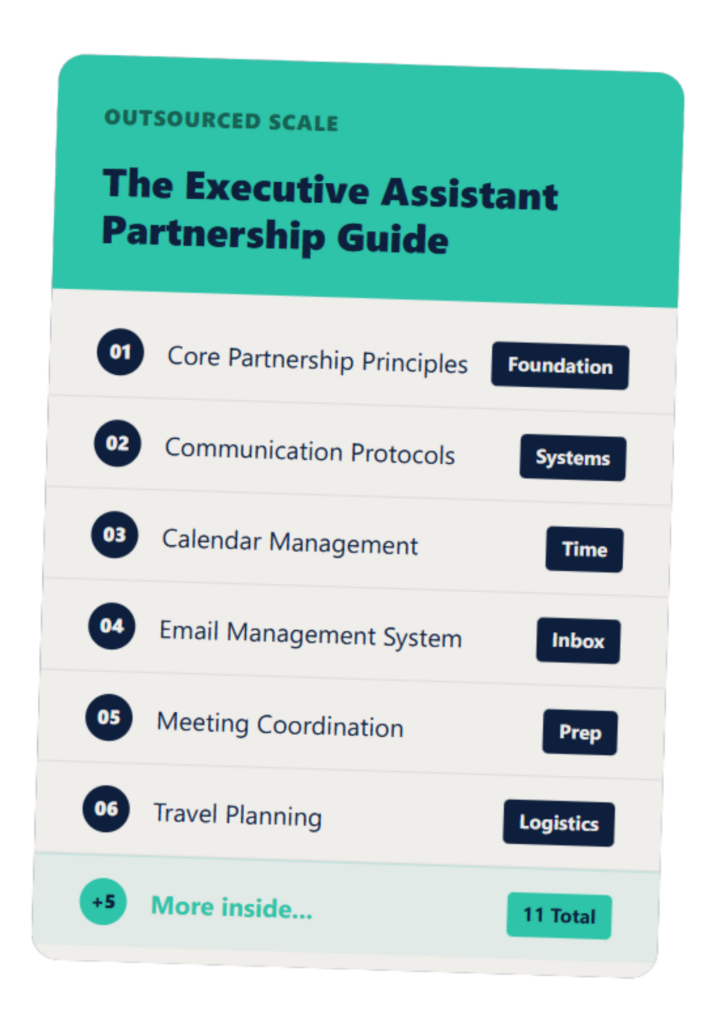
The Executive Assistant Guide
A customizable EA system that helps you and your assistant work smarter—not harder.
How to test for AI fluency in an interview or assessment
Conversational interview questions about AI experience are not enough. An EA can describe their AI fluency convincingly in a 30-minute call and still not be able to produce a well-structured prompt or a clean verified research summary. The resource on how to test EA skills before hiring covers the broader skills assessment design. This section covers the AI-specific test tasks within that framework.
The four test tasks that reveal real fluency
- Task 1 (Prompt fluency): Give the candidate a poorly structured prompt and a sample weak output it produced. Ask them to rewrite the prompt to produce a better result. Evaluate whether their revision shows understanding of context-setting, specificity, and output format instruction, not just whether the result is longer or shorter.
- Task 2 (Research and verification): Give the candidate a research question relevant to your firm’s work. Ask them to produce a one-page summary using any tools they choose, with source citations. Evaluate whether they used AI to assist, whether they verified output against primary sources, and whether they flagged anything they could not confirm independently.
- Task 3 (Workflow description): Ask the candidate to describe a recurring task from a previous role and explain how they would set up an automation to handle it in Zapier or Make. Evaluate whether they can name the trigger, the action, the condition under which it should not fire automatically, and what happens when the trigger fails.
- Task 4 (Output review): Give the candidate an AI-generated document with deliberate errors. Ask them to review it before submission. Evaluate speed, accuracy of error identification, and whether they propose corrections or simply flag and return without context.
The interview questions that reveal real depth
- “Walk me through a prompt you use regularly for a recurring task. What did the original version look like and how has it changed over time?” An EA who has a specific, detailed answer to this question is using AI in workflow. An EA who cannot describe iteration has not refined their prompts through use.
- “Tell me about a time AI gave you output you could not use. What was wrong with it and what did you do?” This question surfaces quality control awareness. An EA who has never caught an AI error has not been reviewing output before it goes out.
- “What tools do you use for workflow automation and what is the most complex thing you have set up?” Evaluate specificity. A vague answer about “using automations sometimes” suggests limited hands-on experience. A specific answer that names triggers, conditions, and failure modes does not.
What to look for in a provider’s AI-training claims
The term “AI-trained” means almost nothing without specifics. It can mean the EA completed an online ChatGPT course, or it can mean they were trained on a documented prompt library, workflow automation tools, and a quality review process before placement. The gap between those two things is real. An AI-trained offshore executive assistant who has been through process-based training is a different hire from one who completed a self-paced online module.
Four questions to ask any provider making AI-training claims
- What AI tools are EAs trained on, specifically? Look for named tools across categories: drafting tools (ChatGPT, Claude), scheduling tools (Reclaim, Motion, Clockwise), automation tools (Zapier, Make), and meeting intelligence tools (Otter.ai, Fireflies). A provider who names only ChatGPT has a narrow training scope that does not cover the full EA tool stack.
- What does their quality control training look like? A trained EA should know how to review AI output before it leaves their screen. If the provider does not address output review in their training, the EA is shipping unreviewed AI output to the executive.
- Is the training documented as a process or is it exposure-based? Process-based training includes documented prompt libraries, workflow templates, and quality control checklists the EA carries into their placement. Exposure-based training is watching a demo and completing a quiz. The difference shows up in day-one output quality.
- How do they measure AI proficiency before placement? Can they show a skills assessment result, a sample task output, or documentation from the training process? If not, “AI-trained” is a marketing claim rather than a verified standard.
What a genuinely trained EA can produce on day one
A properly AI-trained EA should be able to deliver three things in the first week without prompting from the operator: a documented prompt for a recurring task, a research summary with source citations attached, and a description of how they would set up a basic automation for a named workflow in your stack. These three deliverables take under an hour each and directly test whether the training translated into working capability. The technical skills for virtual executive assistants resource covers the broader technical baseline these AI skills sit on top of.
Putting the standard together, what a minimum bar looks like in 2026
The minimum bar for AI fluency in an EA hire in 2026 is not certification, tool count, or years of experience with specific software. It is the ability to write and iterate a prompt, use AI for research without forwarding unverified output, describe at least one workflow they have automated, and review AI-generated drafts before they leave their screen. These four capabilities are testable in under 90 minutes with the tasks described in this article.
Take three things from this article: the five skill categories as a hiring rubric, the four test tasks as an assessment protocol, and the four provider questions as a due-diligence checklist. Together, they close the gap between “AI-trained” as a claim and “AI-fluent” as a verified capability.
If you are looking for an EA who meets the standard described in this article, the 20-minute call is where that conversation starts. We cover what our AI training actually includes, what the testing process looks like before placement, and whether the fit makes sense for your firm. You can book a 20-minute call and see for yourself.
Frequently asked questions
Q: What AI tools should an executive assistant know in 2026?
A competent EA in 2026 should have working knowledge across four tool categories: AI drafting assistants (ChatGPT, Claude), scheduling and calendar tools (Reclaim, Motion, Clockwise), meeting intelligence tools (Otter.ai, Fireflies), and workflow automation tools (Zapier, Make). Fluency across the stack matters more than deep expertise in one tool.
Q: How do I test an EA candidate’s AI skills in an interview?
Task-based testing gives you more signal than conversational questions. Give the candidate a poorly structured prompt and ask them to rewrite it, give them a research question and ask for a verified summary with citations, and give them an AI-generated document with deliberate errors and ask them to review it. The quality of their output on these three tasks reveals whether they have genuine AI fluency or surface familiarity.
Q: What is the difference between an EA who knows AI tools and one who uses them in workflow?
The first profile can name the tools they use. The second has a documented prompt library for recurring tasks, checks AI output before sending, and can describe the automations they have set up. ASAP’s 2024 research found that only 26% of North American administrative professionals use AI on the job at all, which means the majority of candidates who list AI skills on a resume have surface familiarity, not workflow integration.
Q: Does an executive assistant need to know how to build automations in 2026?
Not at a developer level, but yes at a configuration level. A fluent EA should be able to set up a basic trigger-action workflow in Zapier or Make, modify an existing workflow when a step breaks, and explain what each step does. The baseline is whether the EA can implement and maintain documented automations, not build custom ones from scratch.
Q: What does “AI-trained” actually mean when an EA provider claims it?
It depends on the provider. At minimum, it should mean the EA was trained on specific named tools across drafting, scheduling, research, and workflow automation, and that the training was process-based with documented prompt libraries and quality control checklists rather than exposure-based. Ask the provider what tools EAs are trained on, what their output review training covers, and whether they can show a sample skills assessment result before placement.
Q: Is AI fluency more important than traditional EA skills in 2026?
No, it is additional to them. An EA who is fluent with AI tools but cannot manage a complex calendar, communicate clearly with clients, or maintain confidentiality is not a strong hire. AI fluency compounds the value of a skilled EA. The hiring standard in 2026 is strong traditional EA skills plus working AI fluency across the five categories described in this article.