
The most productive companies in 2026 aren’t just using AI. They’re pairing it with the right people. CEOs who are winning right now have figured out something their competitors haven’t: AI tools create leverage, but skilled humans turn that leverage into results. That’s exactly why the smartest operators are combining AI-powered workflows with offshore talent from the Philippines. In this post, we break down how that model works, why it outperforms either approach on its own, and what it looks like in practice for growth-stage U.S. businesses building AI and offshore teams in 2026.
The Productivity Problem AI Alone Can’t Solve
AI tools have gotten remarkably good. Clay can enrich a lead list in seconds. Apollo can sequence a thousand outreach emails before lunch. Make.com can automate workflows that used to take a full-time hire to manage manually.
But here’s the gap no one’s talking about: AI doesn’t manage itself.
Someone has to build the workflows. Someone has to QA the outputs. Someone has to adjust the targeting when a campaign underperforms, update the CRM when data goes stale, and make judgment calls that no prompt can reliably handle. McKinsey’s latest research makes this clear. While 92% of companies plan to increase AI investment, only 1% report having reached mature deployment where AI is fully embedded into workflows driving real business outcomes.
The bottleneck isn’t the technology. It’s the human layer between the tool and the result. And that’s exactly where AI-augmented virtual assistants change the equation.
What CEOs Are Actually Doing Differently in 2026
The playbook has shifted. The CEOs scaling fastest right now aren’t choosing between AI tools and human talent. They’re stacking them.
Here’s what that looks like in practice: instead of hiring a $75K U.S.-based marketing coordinator to run campaigns manually, they’re deploying an offshore assistant trained in AI tools for a fraction of the cost, and getting more throughput. The assistant runs the automation, monitors the output, catches the errors, refines the strategy and they do it across tools that would take a new local hire months to learn.
This isn’t a theory. It’s an offshore productivity strategy that’s already producing measurable results for companies working with Outsourced Scale. Our assistants arrive pre-trained on the exact platforms their teams use daily, so they generate pipeline contributions from the first week, not the first quarter.
The shift is from “hire more people” to “deploy smarter systems with fewer, better-trained people running them.”
Why Offshore Talent + AI Is the Winning Combination

Think of AI as the engine and your offshore assistant as the driver. One without the other either sits idle or crashes into a wall.
AI tools excel at speed, volume, and pattern recognition. They can generate content drafts, score leads, enrich contact data, and trigger multi-step automations faster than any human. But they still can’t do three things well: exercise contextual judgment, build human relationships, or adapt when something breaks.
Offshore talent from the Philippines fills those exact gaps. You get university-educated professionals with strong English fluency, a service-oriented work culture, and the ability to learn new tools quickly, at 60 to 70% less than comparable U.S. hires. When you train that talent on AI-powered systems, you’re not just outsourcing tasks. You’re building a scale engine.
This is what it means to scale business with AI and remote teams. It’s not about replacing humans with bots or replacing bots with bodies. It’s about pairing the right human with the right tool and pointing them at the right outcome.
The AI Stack Philippine Assistants Are Already Trained On
One of the biggest obstacles to scaling with AI is the ramp time. Most new hires, local or offshore, need weeks or months to learn a company’s tech stack. That delay costs you pipeline, momentum, and money.
At Outsourced Scale, we’ve eliminated that bottleneck. Every AI-trained offshore executive assistant and offshore marketing assistant trained in AI tools goes through hands-on training in the platforms growth-stage companies actually use:
- Prospecting and outreach: Apollo, Clay, Instantly, LinkedIn Sales Navigator
- Automation and integration: Make.com, Zapier
- CRM and pipeline management: HubSpot, GoHighLevel, Zoho
- Content and design: Canva, ChatGPT, Claude
- Project management: Asana, ClickUp, Trello, Notion
- Communication: Slack, Google Workspace, Fireflies.ai
Your assistant doesn’t just know what these tools do. They know how to run campaigns, build sequences, manage follow-ups, and generate reports inside them, on Day 1.

Use Cases: Where AI-Augmented Offshore Teams Deliver the Biggest ROI
Not every task benefits equally from the AI + human pairing. Here’s where the model generates the most value:
Outbound prospecting: Your assistant uses Clay to enrich leads, Apollo to build sequences, and Instantly to run multi-channel campaigns. They monitor bounce rates, A/B test subject lines, and push qualified responses to your CRM, all without you touching a thing.
CRM hygiene and follow-up management: Stale data kills deals. An AI-augmented assistant keeps your pipeline clean, moves leads through stages, and makes sure no opportunity falls through the cracks.
Content and campaign execution: From scheduling social posts to repurposing blog content into email campaigns, your assistant uses AI drafting tools alongside your brand guidelines to keep marketing output consistent and high-volume.
Reporting and analytics: Instead of pulling numbers yourself, your assistant runs weekly reports from your CRM, ad platforms, and outreach tools, and flags anomalies before they become problems.
Each of these use cases combines AI speed with human judgment. That’s the unlock. That’s the ROI.
How to Transition From “We Use AI” to “We Scale With AI + People”

If you already have AI tools in your stack but they’re underperforming, the fix isn’t a better tool. It’s a better operator.
Here’s a simple framework for making the shift:
Audit your AI stack. Identify which tools are being used at full capacity and which are running at 20% because nobody’s managing them day to day.
Map the human layer. For each tool, list the tasks that require human oversight: setup, QA, optimization, exception handling, and strategic adjustment.
Hire for the gap. Bring in an offshore assistant who’s already trained on those tools and can run the workflows from week one, not month three.
Measure outcomes, not activity. Track pipeline generated, leads qualified, campaigns launched, and deals influenced. If the number goes up and your time investment goes down, the model is working.
This is the difference between using AI as a novelty and deploying it as a growth lever. And it’s exactly what Outsourced Scale is built to help you do.
Frequently Asked Questions About AI and Offshore Teams
Can AI replace offshore virtual assistants?
No. AI tools are powerful, but they can’t manage themselves. They need human operators to build workflows, monitor outputs, handle exceptions, and make strategic decisions. The highest-performing teams pair AI tools with skilled offshore assistants who know how to use them, creating a compound effect that neither can achieve alone.
How are CEOs using AI to scale teams in 2026?
Forward-thinking CEOs are combining AI-powered automation with AI-trained offshore talent. Instead of growing headcount, they’re growing output, using fewer, better-trained people to run more sophisticated systems. This offshore productivity strategy is already the standard at high-growth companies.
What’s the difference between AI tools and AI-trained assistants?
AI tools are software: Clay, Apollo, Make.com, and ChatGPT. An AI-trained assistant is a human who knows how to use those tools to produce business outcomes. The tool generates the data. The assistant turns it into a pipeline.
How do Philippine VAs use AI tools like Apollo, Clay, and Make.com?
Outsourced Scale’s assistants are trained hands-on in these platforms before they join your team. They build outbound sequences in Apollo, enrich lead data in Clay, automate multi-step workflows in Make.com, and manage everything inside your CRM. They don’t just “know about” AI. They run it daily.
Is it worth hiring an offshore assistant if we already use AI?
Absolutely, and it’s arguably when you need one most. AI tools underperform without someone managing, optimizing, and executing through them every day. An AI-trained offshore assistant is the missing layer between having the tools and getting results from them.
The Multiplier Your AI Stack Has Been Missing
AI is a multiplier, and multipliers only work when there’s something worth multiplying. The CEOs scaling fastest in 2026 aren’t replacing their teams with bots. They’re putting skilled, AI-trained humans in positions where that leverage pays off every single day. Outsourced Scale’s offshore assistants from the Philippines are trained in the exact tools your team already uses: Clay, Apollo, Make, HighLevel, and more. Read more about what an AI-augmented offshore marketing assistant can do for your pipeline, or book a call and we’ll show you the setup that’s working for businesses like yours.
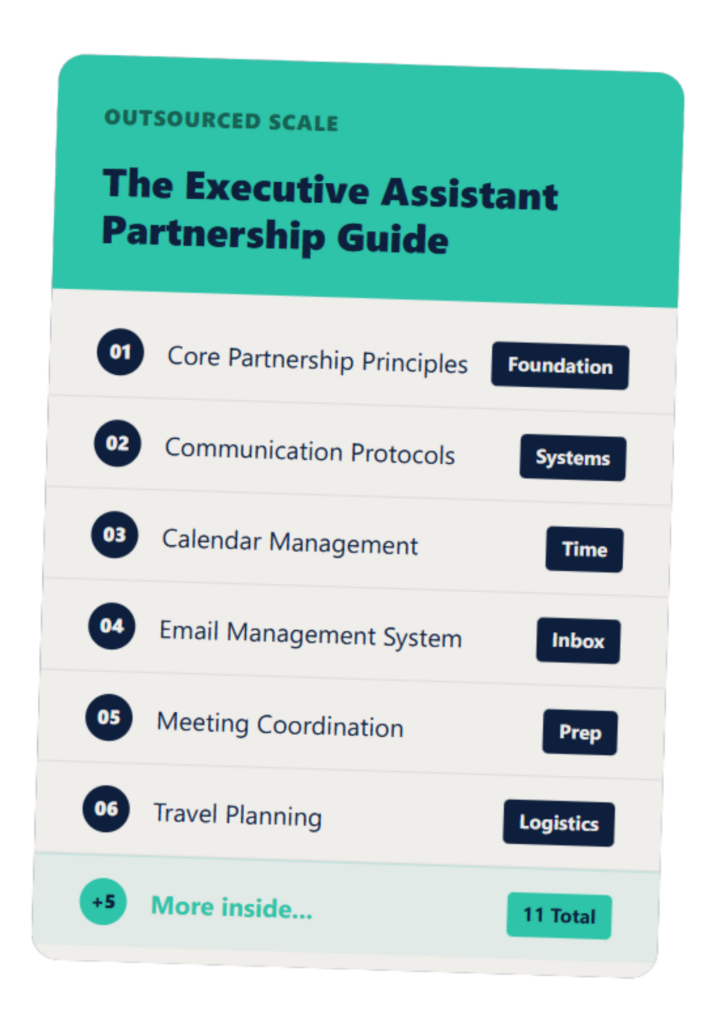
The Executive Assistant Guide
A customizable EA system that helps you and your assistant work smarter—not harder.