
Key Takeaways
- A VA handles assigned tasks and returns them completed; an EA owns recurring workflows and becomes responsible for entire categories of work running correctly.
- Most delegation failures are role mismatches: founders hired a task-taker when their recurring, high-volume admin needed an operational owner.
- The VA model creates coordination overhead when work is recurring and context-dependent because briefing and correction tasks route back to the founder every time.
- By 90 days an EA sends a weekly summary covering what was handled and what needs input, while the rest of the operational layer runs without owner involvement.
- VAs fit project-based, low-frequency, or specialized work; EAs fit scheduling, inbox management, client follow-up, and CRM work that repeats on the same schedule every week.
A virtual assistant handles tasks. An executive assistant owns workflows. Both are useful but they solve different problems. If you have tried delegating before and it created more work rather than less, there is a good chance you hired a task-taker when you needed an operational owner. This article explains the distinction and helps you identify which role fits your situation.
What a virtual assistant relationship actually looks like in practice
A VA is typically paid per hour or per project, works for multiple clients, and handles tasks as assigned. The relationship is transactional by design, and for the right use case, it works well.
The VA model: task-in, task-out, no ownership of outcomes
In a VA relationship, you assign a task, the VA completes it, and the interaction ends. There is no expectation that the VA will anticipate the next task, remember how you handled something last month, or flag a pattern they noticed across your inbox. The model is built for defined, contained work. It is not built for ongoing operational ownership.
InboxDone’s comparison of VA and EA roles notes that VA positions are growing at roughly twice the rate of EA roles, which reflects both the accessibility of the VA model and the breadth of situations where task-based support is genuinely what is needed.
Where VAs excel: project-based work, specialized skills, flexible volume
VAs are well-suited for work that is project-based, low-frequency, or requires a specific skill set you need occasionally rather than consistently. Graphic design, research projects, data entry sprints, social media content batches, and one-time document builds are all natural VA work. The model works because the task is self-contained and the relationship does not need to compound over time to produce results.
Why the VA model often falls short for time-strapped founders with recurring needs
The VA model creates friction when the work is recurring, high-volume, and context-dependent. Calendar management, inbox triage, client follow-up, and CRM updates all require someone who knows your systems, your preferences, and your clients. A rotating cast of task-based workers resets that context every time. You spend more time briefing than you save delegating.
What an executive assistant relationship actually looks like in practice
An EA works for one employer, owns a defined set of recurring workflows, and deepens their knowledge of your systems and preferences over time. The relationship compounds.
The EA model: owns workflows, not just tasks
In an EA relationship, you transfer ownership of a workflow, not individual tasks. Calendar management is not “please schedule this meeting.” It is “you own my calendar.” Inbox triage is not “here is one email to respond to.” It is “you manage my inbox and flag what needs my attention.” The EA becomes the person responsible for that category of work running correctly, not just completing individual items within it.
ProAssisting’s analysis of executive assistant responsibility level distinguishes EAs by their ownership of ongoing operations rather than project completion, noting that EAs provide operational continuity that task-based models structurally cannot.
The executive assistant skills guide covers the specific competencies that distinguish an EA from a general VA in a service firm context. The AI-trained EA capabilities breakdown covers how modern offshore EAs apply AI tools within their workflow ownership.
How the EA relationship evolves over the first 60-90 days
In week one, the EA observes and learns. By week two, they are handling the first task set. By week eight or twelve, they are managing workflows you have not thought about in weeks because nothing has gone wrong. The relationship does not reset. It compounds. Each week the EA builds more context about your clients, your preferences, and your systems, which makes their output more accurate and their need for your input lower.
What operational independence looks like at 90 days vs day one
On day one, the EA needs direction on almost every task. At 90 days, they send a weekly summary of what was handled, what is pending, and the two or three items that genuinely need your input. The rest runs without you. That shift is what makes the EA model structurally different from task-based support.
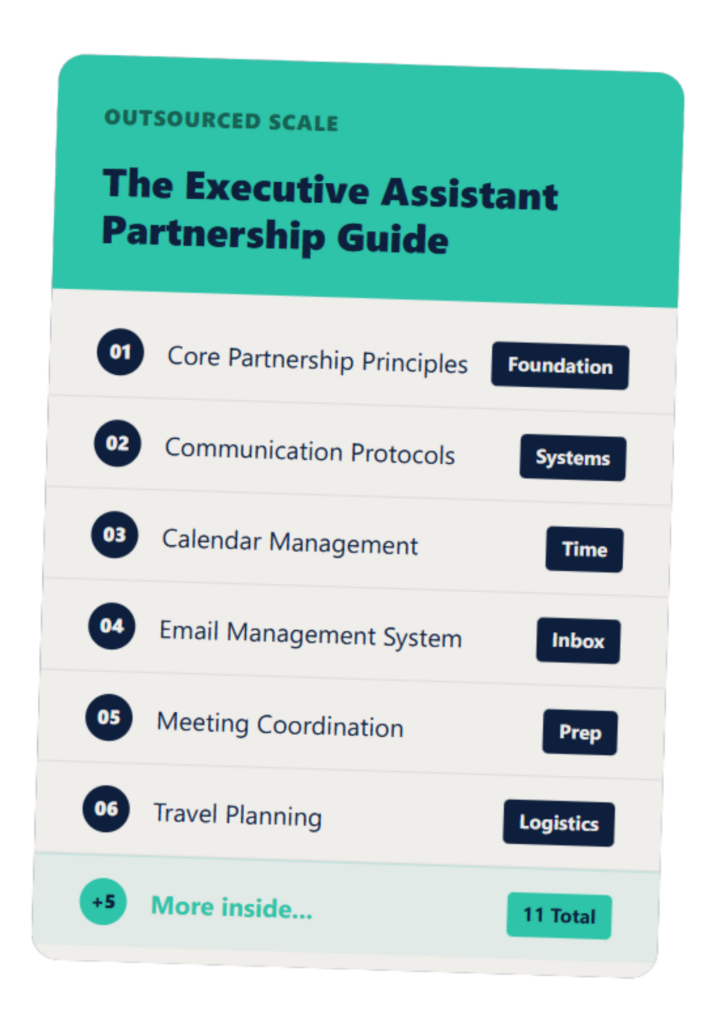
The Executive Assistant Guide
A customizable EA system that helps you and your assistant work smarter—not harder.
Why most delegation failures are wrong-role failures
When founders say “I tried delegating and it did not work,” the follow-up question is: what kind of support did you hire? In most cases the answer reveals a role mismatch, not a delegation problem.
The coordination overhead problem: VAs that create more work than they save
The failure pattern is consistent. You hire a VA to handle scheduling. The VA schedules meetings but does not notice the conflict with your blocked focus time. You fix it. The VA sends a follow-up email but uses the wrong template. You correct it. Every task handed off generates a correction task that routes back to you. The VA is completing work. You are still coordinating it.
The ownership gap: tasks that come back uncompleted because no one owns the outcome
The ownership gap is what happens when a task is delegated but the responsibility for the outcome is not. A VA who was asked to “handle the scheduling” and encounters an ambiguous situation will often pause and ask rather than decide. That is the right behavior for a task-taker. It is the wrong structure for an owner. An EA who owns the calendar makes the decision, notes it, and tells you after. The gap between those two behaviors is where founder time gets consumed. The guide on building offshore teams that actually deliver covers the structural differences between task-delegation and workflow-transfer at the team level.
Why VAs need more active management than EAs as a structural model
VAs are not harder to manage because they are less skilled. They need more active management because the task-based model requires a coordinator, and that coordinator is you. Every task needs a brief. Every handoff needs a check. Every new situation needs a decision from the person who owns the outcome. That person is still you. An EA model transfers the coordinator role itself. You stop being the person who manages the work and become the person who reviews the summary.
How to know which role you actually need
The answer depends on what you need to delegate and how frequently. Neither role is universally better. It is a match question, not a quality question.
You need a VA if: your work is project-based, low-frequency, or highly specialized
If you need a research project completed, a batch of content produced, a data set cleaned, or a specialized technical task handled, a VA is the right tool. The work is scoped, the output is defined, and the relationship does not need continuity to deliver results.
You need an EA if: your admin is recurring, high-volume, and requires system familiarity
If your biggest time drain is scheduling, inbox management, client follow-up, CRM updates, or document coordination, you need an EA. These tasks recur on the same schedule every week, require knowledge of your clients and systems to do well, and compound in value as the EA builds familiarity. The full list of tasks to delegate to an EA covers the complete transfer inventory for service firm owners. The guide on whether hiring an EA is worth it walks through the decision criteria for service firm owners who are at the evaluation stage. The offshore growth assistant blueprint covers how firms at growth stage structure the EA role alongside other offshore positions.
The hybrid model: when it makes sense to use both
Some service firm owners use an EA for recurring operational work and a specialist VA for periodic project work. This is a sensible structure when the two categories are genuinely distinct. The EA owns the operational layer. The VA handles the project work that falls outside it. The key is that the EA’s scope is defined clearly enough that the VA work does not bleed into it and create the coordination problem again.
FAQs About Virtual Assistant vs Executive Assistant
What is the main difference between a VA and an executive assistant?
A VA handles tasks as assigned, often for multiple clients, with no ownership of outcomes; an EA owns a defined set of recurring workflows for one employer, deepening system knowledge over time. The distinction is ownership, not skill level.
Can a VA do the same work as an executive assistant?
Some VAs have EA-level skills, but the difference is the relationship structure. An EA who works exclusively for you and learns your systems over months produces compounding results a rotating task-based VA cannot replicate.
Is an EA more expensive than a VA?
Full-time offshore EAs through a managed provider typically cost $1,200-$2,000 per month; the more relevant distinction is what the model delivers, workflow ownership versus task execution, rather than the monthly rate difference.
What should I delegate to a VA vs an EA?
Delegate project-based, specialized, or one-time tasks to a VA; delegate recurring workflows requiring consistency and system familiarity to an EA, including calendar management, inbox triage, and client follow-up.
Why did delegation fail for me before?
The most common reason is the task-taker model: handing off individual tasks without transferring ownership of the underlying workflow, which leaves you as the coordinator rather than removing you from that role.
If the EA model is what your situation calls for, the next step is a conversation about scope. Book 20 minutes here and we will map what a correctly structured EA role looks like for your firm.