

Key Takeaways
- Month-to-month arrangements let you confirm fit before committing, and a provider willing to offer them is signaling confidence in their own service quality.
- Fixed-term contracts primarily protect provider revenue, and discounts for longer commitments transfer the exit risk from the provider to the buyer.
- Three contract terms require close reading before signing: auto-renewal clauses, minimum billable hour requirements, and cancellation fees beyond standard notice periods.
- A managed provider should replace an underperforming EA as part of the service, not as a separate billable event charged to the client.
- Longer commitments make sense only after fit is confirmed, core workflows run independently, and scope is expected to stay consistent for the full term.
Month-to-month arrangements give you the flexibility to test fit without locking in before you know what delegation looks like for your firm. Fixed contracts make sense only after fit is proven. Buyers who regret their offshore EA choice typically signed a long-term commitment before understanding what they were committing to.
What month-to-month arrangements give you as a buyer
Month-to-month is not a sign of a low-quality provider. It is what a confident provider offers because they expect you to stay, not because they need to lock you in.
Exit flexibility during the first 30-60 days when fit is still being established
The first 30-60 days with any EA is a calibration period. The fit between your working style and the EA’s execution takes time to confirm. A month-to-month arrangement means that if fit is not right, you can exit without penalty rather than navigating a cancellation clause you did not read closely enough when you signed.
For context on what pricing looks like across provider types, current offshore EA pricing in 2026 covers the full range from hourly to monthly retainer. The offshore vs US EA full cost comparison is useful if you are comparing offshore with domestic options at the same time.
No penalty for reducing scope if your needs change
A month-to-month arrangement also gives you room to adjust scope without triggering financial penalties. If your workload drops, if you bring a task in-house, or if you want to pause while onboarding a new team member, a flexible arrangement accommodates that without a conversation about contract minimums.
The signal month-to-month sends about the provider’s confidence in their service
A provider willing to work month-to-month is signaling that they expect the relationship to continue on its own merits. A provider that requires a six or twelve-month commitment upfront is protecting against the possibility that you will leave. That is a meaningful distinction worth noting before you sign.
What fixed-term contracts give providers, and what that means for you
Long-term contracts primarily protect the provider’s revenue. Understanding why providers push them helps you evaluate the offer clearly.
Why providers offer discounts for longer commitments
The standard justification for a discount on a longer commitment is that the provider can plan their staffing more reliably. That is true. It is also true that the discount transfers the exit risk from the provider to you. Before accepting a discount for a longer term, confirm that fit is already established. A 10% discount on a service that is not working is not a saving.
Anywhere Talent’s cost analysis of offshore EA total cost of engagement notes that the real cost includes onboarding time and management overhead beyond the monthly rate. A longer contract that includes a replacement guarantee is different from one that does not. Read both carefully. The breakdown of virtual EA pricing hourly vs monthly retainer covers the pricing structures worth understanding before you choose a model.
Fine print to read: auto-renewal clauses, minimum hour requirements, cancellation fees
Three contract terms warrant close reading before signing. Auto-renewal clauses that trigger unless cancelled within a short window are easy to miss and expensive to exit after the fact. Minimum hour requirements that bill you for hours whether you use them or not reduce flexibility significantly. Cancellation fees beyond a standard notice period are a cost you should understand clearly before they apply.
When a longer commitment does make sense, and what to negotiate before agreeing
A longer term makes sense when fit is confirmed, the EA is running core workflows independently, and you are confident the scope will remain consistent for the period you are committing to. At that point, a modest discount for a longer term is a reasonable trade. Before agreeing, negotiate on three points: the replacement policy if the EA leaves or underperforms, the notice period for cancellation, and whether the rate is fixed for the full term.
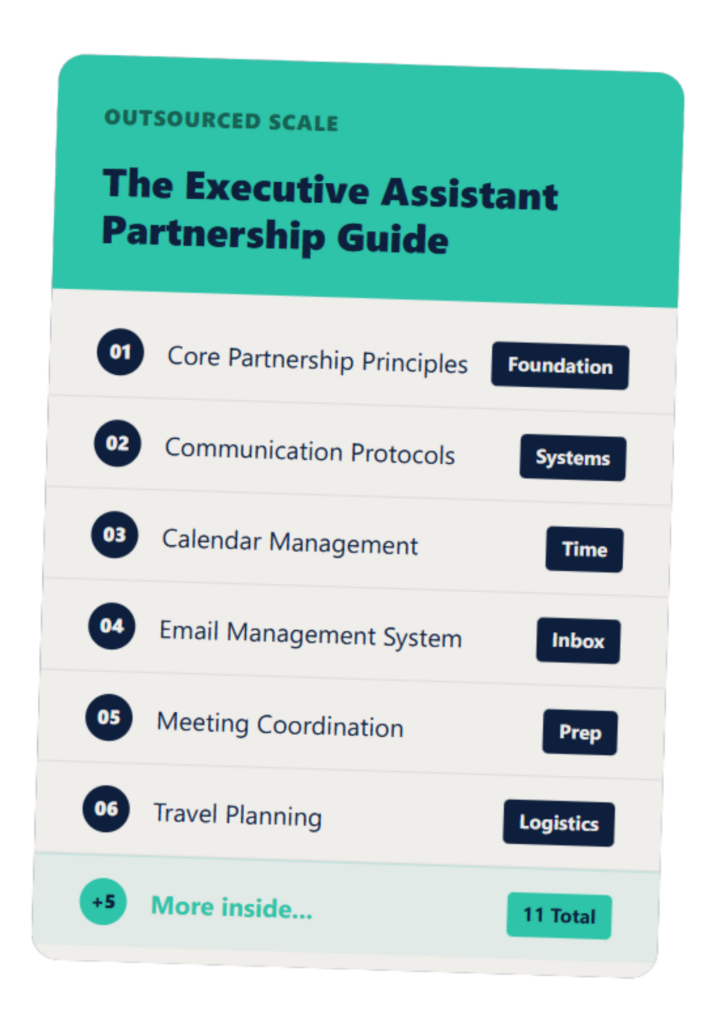
The Executive Assistant Guide
A customizable EA system that helps you and your assistant work smarter—not harder.
Five questions to ask every offshore EA provider before signing
These questions surface the information most buyers wish they had asked before committing.
What is the minimum notice period to cancel or reduce scope?
Thirty days is standard and reasonable. Anything longer than thirty days disproportionately favors the provider. Ask this question directly and get the answer in writing before signing.
What happens if the EA is not a good fit: how is replacement handled?
A managed provider should replace an underperforming EA as part of the service, not as a billable event. Ask how long a replacement takes, whether you pay during the gap, and how many replacements are included. The guide on best way to hire an offshore EA covers the provider evaluation criteria worth applying before you decide. The best executive assistant outsourcing companies comparison covers how different providers structure replacement and quality guarantees.
Are there any fees beyond the monthly rate: setup, account management, replacement?
Setup fees, account management fees, and replacement fees are all costs that may not appear in the headline rate. Ask for the total monthly cost including all fees before comparing providers. A lower headline rate with setup and replacement fees may cost more than a higher rate with those costs included.
Does the rate change if I add or reduce hours?
Some providers have step pricing that changes at certain hour thresholds. Others charge a flat rate regardless of actual hours used. Know which model applies before you sign and confirm whether reducing hours triggers a rate change or a minimum billing requirement.
What is the ramp-up period and when is full productivity expected?
A provider who cannot give you a clear answer on this is worth pressing. Core tasks should reach independent operation within 30-60 days. If the provider’s answer is vague or open-ended, ask what the onboarding structure looks like week by week.
Red flags in offshore EA contract language
These terms appear in contracts that favor the provider over the client.
Auto-renewal with short cancellation windows: easy to miss, expensive to exit
A contract that auto-renews unless cancelled within 14 or 21 days of the renewal date is designed to be missed. Set a calendar reminder the moment you sign. If a provider requires this clause, ask for it to be extended to 30 days or removed entirely.
Replacement fees: you should not pay to fix a bad match
A managed provider that charges you to replace an EA they placed is shifting responsibility for their own match quality onto you. This is a red flag regardless of how it is framed in the contract.
Minimum billable hours regardless of actual usage
A minimum billing clause charges you for hours whether your EA works them or not. This is not inherently unreasonable for a full-time placement, but it should be explicit and you should know the number before signing. For context on what part-time arrangements typically cost and how minimums work at lower hour counts, part-time EA cost for small businesses covers the relevant structure.
FAQs About Monthly vs Contract Offshore EA
Should I sign a long-term contract with an offshore EA provider?
Not before fit is proven. A month-to-month arrangement gives you time to confirm the EA is working well before committing to a longer term; once fit is established, a longer arrangement may offer savings worth considering.
What is a fair cancellation notice period for an offshore EA?
Thirty days is standard and reasonable; notice periods of 60 or 90 days disproportionately favor the provider.
Is it common for offshore EA providers to charge replacement fees?
It happens, but it is a red flag. A managed provider that monitors performance should handle replacement as part of the service.
Can I negotiate contract terms with an offshore EA provider?
Yes, particularly on notice periods, replacement policies, and minimum hour requirements; ask explicitly for month-to-month terms, as many providers will offer them without reducing service quality.
What does a fair month-to-month offshore EA arrangement cost?
Full-time month-to-month offshore EA support typically costs $1,200-$2,000 per month; discount incentives for longer commitments typically range from 5-15%.
If you are evaluating providers and want to know how Outsourced Scale structures its arrangements, that is a good 20-minute conversation. Book here and we will tell you exactly what the terms look like before any commitment.