Every hour you spend chasing missing W-2s is an hour you’re not reviewing returns.
Tax season turns most accounting firms into high-volume production environments. The firms that manage the surge best separate preparation work from administrative coordination. When partners spend mornings tracking down client documents instead of reviewing completed returns, the backlog compounds.
This guide explains what your executive assistant should handle during tax season, what requires supervision, and what should remain with licensed CPAs.
Key Takeaways
- Tax season slowdowns usually come from administrative coordination, not technical tax work. Missing documents, client delays, and unclear status tracking create most return backlogs.
- Executive assistants should manage client communication such as scheduling appointments, requesting missing documents, sending reminders, and providing return status updates.
- Assistants can organize client documents, prepare checklists of received and missing files, and structure tax folders so preparers start work with complete information.
- Deadline coordination fits well with EA support. Assistants can track filing deadlines, manage extension lists, and alert staff when returns risk missing due dates.
- Preparation support tasks like sorting source documents, preparing workpaper templates, and coordinating the preparation queue help returns move faster through the workflow.
- Licensed CPAs should retain responsibility for final return review, compliance decisions, and tax planning advice that requires professional judgment.
- The goal of delegation during busy season is protecting CPA time for reviewing returns and advising clients while assistants handle communication, documents, and workflow coordination.
Why delegation matters during tax season
During busy season, the bottleneck usually is not technical tax work. It is administrative coordination.
The returns pile up not because your preparers are slow, but because documents arrive incomplete, clients miss deadlines, and nobody has time to follow up. By mid-March, your inbox becomes a graveyard of half-finished client folders.
The tax season workflow problem
A typical workflow inside a CPA firm moves through predictable stages:
- Client submits documents to the firm
- Administrative staff organizes files into the correct folders
- Preparer inputs data and drafts the return
- Senior reviewer checks the return for accuracy and compliance
- Final approval triggers e-file submission
If the early administrative steps are slow, the entire workflow stalls. A return sitting in “waiting for documents” status for two weeks creates pressure that cascades through every downstream step.
Most firms don’t have a preparation problem. They have a coordination problem.
Where executive assistants fit in
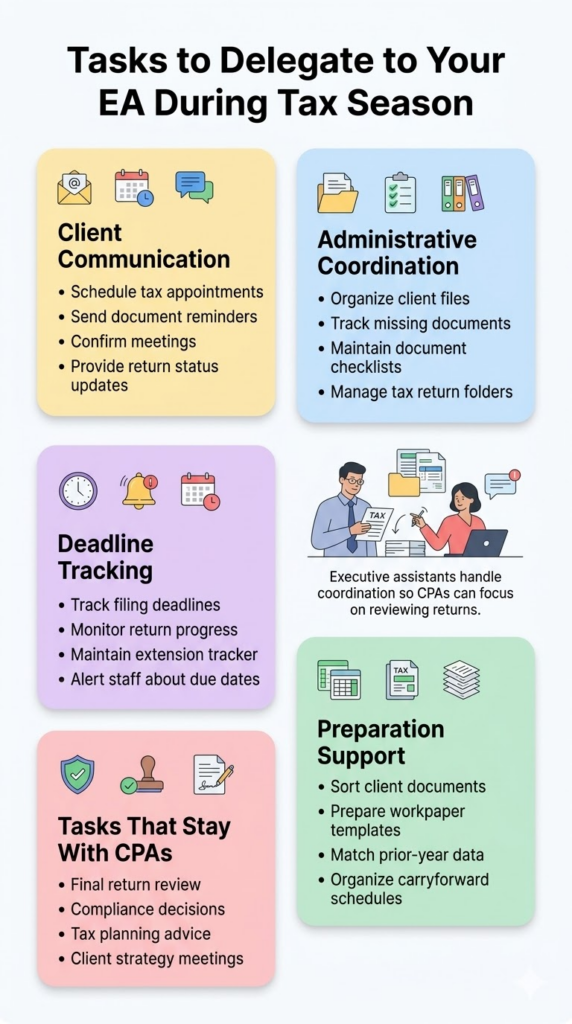
Executive assistants can manage document organization, communication, and deadline tracking so CPAs can focus on review and advisory work.
When administrative tasks move to an assistant, your licensed staff stops context-switching between chasing documents and reviewing returns. The separation lets each role operate at full capacity instead of everyone doing a little of everything poorly.
Client communication tasks to delegate
Client communication during tax season is high volume but low complexity. Most messages follow predictable patterns that an assistant can handle without CPA involvement.
Appointment scheduling
Assistants can coordinate the calendar logistics that otherwise interrupt your day:
- Scheduling consultation calls for new and returning clients
- Booking tax preparation appointments and managing the firm’s availability
- Confirming meetings and sending reminders to reduce no-shows
- Rescheduling when conflicts arise without requiring partner involvement
Every scheduling email an assistant handles is an interruption removed from your workday.
Document request follow-ups
The repetitive work of chasing missing documents fits well with assistant delegation:
- Requesting missing W-2s from clients who submitted incomplete packages
- Following up on 1099 forms that haven’t arrived
- Sending reminder messages about required documents before preparation begins
- Tracking which clients have responded and which need additional outreach
Assistants can run these follow-up sequences daily without guidance once they understand which documents each return type requires.
Client status updates
Keeping clients informed reduces inbound questions that interrupt your work:
- Notifying clients when documents are still missing from their file
- Updating clients on return progress and expected completion timing
- Scheduling review meetings once returns are ready for discussion
- Confirming e-file acceptance and providing copies of completed returns
Proactive updates from your assistant prevent the “where’s my return?” calls that derail your afternoon.
Administrative tasks your EA should handle
Beyond client communication, administrative coordination keeps the firm running during busy season.
Organizing client documents
Document management is time-consuming but does not require tax expertise:
- Collecting files submitted through client portals and email
- Organizing documents into standardized tax return folders
- Preparing document checklists showing what’s received and what’s missing
- Flagging incomplete submissions for follow-up before preparation starts
When files arrive organized and complete, preparers can begin work immediately instead of sorting through disorganized submissions.
Extension tracking
Extension management requires attention to deadlines, not tax judgment:
- Tracking which clients need extensions filed before the April deadline
- Monitoring document deadlines for extended returns
- Identifying incomplete client submissions that put extension eligibility at risk
- Coordinating with clients to confirm extension filing decisions
An assistant maintaining an extension tracker prevents the scramble of discovering unfiled extensions on April 14th.
Deadline management
Deadline visibility keeps the firm moving without partner oversight:
- Monitoring filing deadlines for individual and business returns
- Sending reminders to preparers about approaching due dates
- Maintaining internal task boards showing return status and bottlenecks
- Alerting managers when returns risk missing deadlines
When deadline tracking happens systematically, nothing falls through the cracks during the busiest weeks.
Tax preparation support tasks
Some preparation support tasks don’t require CPA credentials but do require coordination with your technical staff.
Data preparation
Assistants can prepare supporting documents so preparers start with organized files:
- Sorting source documents by category before preparation begins
- Matching prior-year return data with current-year submissions
- Preparing workpaper templates for preparer completion
- Organizing carryforward schedules from prior returns
Preparation support reduces the time preparers spend on setup before they begin technical work.
Preparer coordination
Managing the preparation queue keeps returns moving:
- Assigning returns to preparers based on availability and complexity
- Tracking preparation progress across the active return queue
- Monitoring review queues to identify bottlenecks
- Communicating status updates between preparation and review teams
Assistants coordinating the queue prevent returns from sitting idle between stages.
Quality review coordination
Review corrections require back-and-forth that an assistant can manage:
- Routing review notes from reviewers back to preparers
- Tracking correction status on returns awaiting revision
- Coordinating timing between preparers and reviewers for final sign-off
- Documenting recurring issues for process improvement after busy season
Coordination support helps corrections move quickly without requiring reviewer involvement in logistics.
Tasks that should stay with CPAs
Clear boundaries protect both quality and compliance.
Final return review
Only licensed CPAs should approve tax returns and confirm compliance decisions. The review step requires professional judgment about positions taken, accuracy of reported figures, and signing responsibility.
Assistants can coordinate the review process, but the judgment call belongs to credentialed professionals.
Tax planning and advisory work
Strategic tax planning involves complex judgment calls that require experience and licensure:
- Evaluating entity structure decisions
- Analyzing timing strategies for income and deductions
- Advising on retirement contribution optimization
- Recommending estimated payment adjustments
Advisory work represents the highest-value service your firm provides. Protecting CPA time for this work is the point of delegation.
How to start delegating before busy season
The best time to prepare delegation workflows is before tax season begins. Scrambling to train an assistant in February creates more problems than it solves.
Create a tax season task checklist
List every responsibility your assistant will manage during busy season:
- Which client communications they handle independently
- Which document management tasks they own
- Which deadline tracking systems they maintain
- Which coordination responsibilities they manage between staff
A documented checklist prevents confusion about who handles what when volume increases.
Train your assistant on workflow systems
Assistants should understand your firm’s specific systems before busy season starts:
- Tax software workflows and how returns move through stages
- Document management systems and folder structures
- Client communication templates and firm voice
- Review procedures and how corrections flow between staff
Training in December means your assistant operates independently by January. For a structured approach to building assistant capability, see the guide on building an executive assistant 30-60-90 plan.
Managing your executive assistant during busy season
Clear management systems help delegation work during peak workload periods. Without structure, delegation creates confusion instead of capacity.
Daily check-ins keep priorities aligned without lengthy meetings. A five-minute morning standup confirms what your assistant will focus on and surfaces blockers before they slow progress.
Weekly reviews address patterns rather than individual tasks. Which client communications are taking too long? Which deadline tracking gaps need process fixes?
For detailed guidance on ongoing management, see how to manage an executive assistant. If you’re still in the hiring phase, the guide on how to hire a virtual executive assistant covers what to look for before busy season starts.
When CPA firms add offshore EA support
Many accounting firms add offshore assistants to handle administrative coordination during busy season. The cost difference compared to local hires makes seasonal scaling more practical.
Offshore assistants working Philippines hours can process overnight document submissions so your preparers start each morning with organized files. The time zone difference becomes an advantage when administrative work happens while your office sleeps.
For firms evaluating the investment, the analysis of executive assistant ROI breaks down when the numbers make sense. Understanding virtual EA pricing models helps compare hourly versus monthly arrangements for busy season coverage.
Firms looking for assistants who already understand productivity tools and workflows can explore what an AI-trained executive assistant brings to administrative coordination.
Protecting CPA time during the busiest weeks
Tax season pressure comes from volume rather than complexity. The technical work isn’t harder in March than it is in July. There’s just more of it arriving faster with tighter deadlines.
Firms that separate administrative coordination from professional tax work move faster and reduce bottlenecks. When executive assistants manage communication, documents, and deadlines, CPAs regain time for return review and client advisory.
The goal isn’t working more hours during busy season. It’s protecting the hours you work for the highest-value activities only you can perform.
If you’re preparing for busy season and want help building delegation workflows for offshore support, schedule a conversation to discuss what CPA firms typically delegate and how to get an assistant productive before tax season starts.
FAQs about HR Companies Executive Assistant Skills
Executive assistants typically manage scheduling, client follow-ups for missing documents, appointment confirmations, return status updates, document organization, extension tracking, and deadline reminders so CPAs can focus on reviewing returns.
Delegation keeps licensed staff focused on technical work instead of chasing documents or answering routine client questions. When assistants handle coordination, returns move faster through preparation and review stages.
Yes. Assistants can request missing W-2s, 1099s, and other required documents, track which clients have responded, and send reminder messages until submissions are complete.
Yes. Assistants can collect files from portals or email, place them in the correct folders, create checklists of received documents, and flag incomplete submissions before preparers begin work.
Assistants can maintain deadline trackers, monitor filing dates for individual and business returns, and notify staff when returns risk missing deadlines. They can also maintain extension tracking lists during busy season.