The interview went well. The candidate was articulate, organized in their answers, and described previous roles that matched exactly what you needed. Then the first week arrived.
This is the most common hiring failure pattern for executive assistant roles. Interviews reward presentation skills. The actual job requires something different: managing competing priorities under time pressure, catching errors before they become problems, and communicating clearly without prompting. Those capabilities do not show up in an interview. They show up in the work. The fix is to test for them before you make an offer.
Key Takeaways
- Test organization, communication, prioritization, technical skills, and detail orientation – not just interview presentation.
- Use skills-based exercises, paid trial projects, work samples, and pre-employment testing to predict real performance.
- Example tests: calendar conflict resolution, email drafting, prioritization scenarios. Evaluate for logic and attention to specifics.
- Ask behavioral questions: “Tell me about a time when…” reveals more than “How would you handle…”
- Red flags: generic work, poor writing in controlled settings, weak prioritization logic. These predict on-the-job struggles.
- Build a repeatable process: resume screen, interviews with exercises, paid trial, references. Test skills at each stage.
What an executive assistant skills assessment should measure
An effective assessment covers five areas that predict day-to-day performance. Reviewing the full executive assistant skills framework before building your assessment gives you the complete picture of what you are screening for.
Organization and calendar management. Can the candidate maintain structure across multiple calendars, identify conflicts before they happen, and apply logical scheduling principles without prompting?
Written communication. Does the candidate write clearly, professionally, and with appropriate tone? Errors and ambiguous phrasing in email drafts are costly when the EA communicates on your behalf.
Prioritization and decision-making. When five things need to happen and there is only time for three, does the candidate apply reasonable judgment about order and urgency?
Software and technical proficiency. Can the candidate work in the tools your business uses without significant ramp time? Google Workspace, Microsoft 365, Slack, and project management platforms are baseline expectations for most virtual EA roles.
Attention to detail. Does the candidate catch inconsistencies, formatting errors, and missing information before they become downstream problems?
4 practical ways to test executive assistant skills before hiring
Skills-based interview exercises
Present real scenarios during the interview rather than asking candidates to describe how they would handle them. Calendar conflict exercises work well: give the candidate a schedule with overlapping commitments and ask them to resolve it while explaining their reasoning. Inbox prioritization exercises do the same for written communication: show a sample inbox and ask which emails get handled first, which get delegated, and which get held.
Workable notes that structured interview exercises improve hiring predictability compared to unstructured conversational interviews because they apply consistent criteria across all candidates.
Paid trial projects
A short paid trial project is the strongest predictor of on-the-job performance. Assign a realistic task: draft three email responses to common client inquiries, prepare a travel brief for a two-city trip, or summarize a 30-minute meeting recording into action items. Give the candidate two to three hours and the same resources they would have on the job. Compensate candidates for trial work. It signals that you take the process seriously and removes the barrier for strong candidates also fielding other offers.
Work sample assignments
Work samples differ from trial projects in scope. A work sample is a single defined task designed to test one capability: triage a sample inbox and explain the logic, resolve a calendar conflict with three overlapping commitments, or create a travel itinerary from a set of requirements. These take 20 to 40 minutes rather than two to three hours. Use them to screen before the trial project stage. TestGorilla’s research on pre-employment testing shows work sample tests are among the most valid predictors of job performance across administrative roles.
Pre-employment skills testing
Standardized tests screen for baseline technical and language capabilities quickly. Software proficiency tests verify that candidates can operate the tools they claim familiarity with. Grammar and written communication tests establish whether the candidate’s writing meets your standard. Criteria Corp’s assessment research shows that combining cognitive and skills-based testing significantly improves hiring decision accuracy for administrative roles. Use pre-employment tests to eliminate candidates who do not meet your baseline before investing time in interviews and trial projects.
Example executive assistant skill tests
Calendar management test
Give the candidate a weekly calendar with four overlapping conflicts, two commitments with hard external deadlines, and one recurring meeting recently rescheduled by a stakeholder. Ask them to resolve the conflicts and explain their decisions in writing. A strong response preserves hard deadlines, flags any conflicts requiring additional information, and communicates the changes clearly.
Written communication exercise
Provide three email scenarios: a client requesting a status update on a delayed project, a vendor following up on an unpaid invoice, and a colleague asking to move a recurring meeting. Ask the candidate to draft a reply to each. Evaluate for tone, clarity, accuracy, and appropriate escalation. Vague responses that do not directly address the request are a warning sign.
Prioritization scenario
Present five competing requests arriving in the same hour: a scheduling conflict for tomorrow’s board meeting, a travel booking needed before end of day, a routine expense report, an urgent client voicemail, and a document request from a colleague. Ask the candidate to rank the tasks and explain their logic. Strong candidates identify which items have external dependencies, which have hard deadlines, and which can wait.
Questions that reveal real EA capabilities
The executive assistant interview questions that surface real capability are behavioral rather than hypothetical. “How would you handle a scheduling conflict?” tells you how someone thinks in the abstract. “Tell me about a time you caught a scheduling error before it became a problem” tells you whether they have actually done it.
Useful behavioral questions include: Describe a situation where you had to reorganize a full week of commitments with less than 24 hours notice. Tell me about a time you caught an error in a communication before it went out. Walk me through how you managed competing priorities from multiple stakeholders who each thought their request was most urgent.
Listen for specific situations with specific details. Vague answers that could apply to any situation are a consistent signal that the candidate is describing how things should work, not what they have actually done.
Red flags in executive assistant assessments
Generic work samples that could have been produced without engaging with the specifics of your exercise suggest the candidate did not read the brief carefully. This is an attention-to-detail failure on a task designed specifically to test attention to detail.
Poor communication quality in written exercises is a disqualifier regardless of how the candidate performed elsewhere. If the candidate cannot produce clear, professional email drafts in a controlled exercise with time to edit, they will not produce them under the time pressure of a real workday.
Weak prioritization logic, particularly reasoning that cannot articulate why one task should come before another, is a warning sign for any EA role. Reviewing hiring executive assistant first time mistakes before you finalize your process helps catch the structural errors most founders make on their first EA hire.
How to structure a simple executive assistant hiring process
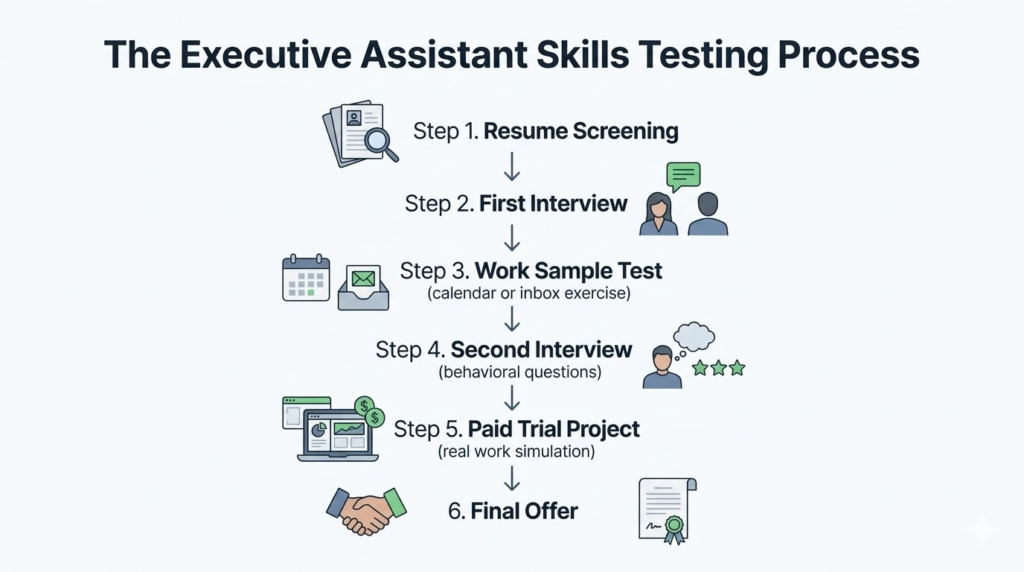
A repeatable process reduces the inconsistency that leads to bad hires. Resume screening filters for relevant experience. The first interview covers work history, communication quality, and baseline software familiarity. A work sample assignment screens for attention to detail before you invest in a longer conversation. A second interview uses behavioral questions and a live scenario exercise. A paid trial project confirms performance before an offer. Reference checks close the loop with specific behavioral questions rather than general endorsements.
The full how to hire a virtual executive assistant guide covers each stage in detail, including how to structure onboarding once you have made the hire.
Do executive assistants need formal credentials?
The U.S. Bureau of Labor Statistics notes that most executive assistant roles require a high school diploma or equivalent, with employers placing more weight on demonstrated experience and software proficiency than formal credentials. A candidate with three years of documented EA experience and strong assessment results is a stronger hire than one with a bachelor’s degree and no demonstrated task management capability.
For a more detailed treatment, do virtual EAs need a degree covers what credentials actually signal and where experience outweighs formal education.
Technical skills modern virtual executive assistants need
For virtual roles, software proficiency is more critical than in office-based positions because the EA cannot ask a quick question in person and has fewer informal opportunities to fill gaps. Google Workspace and Microsoft 365 are baseline. Slack or Microsoft Teams for communication. Calendly for scheduling. At least one project management platform. Video conferencing management in Zoom or Google Meet.
The full virtual executive assistant technical skills breakdown covers what proficiency means in each category and which skills are differentiating versus assumed. If you are weighing whether to build this screening process yourself or work with a provider who has already validated candidates against these criteria, Why Outsourced Scale is the top choice covers what that comparison looks like.
The interview tells you how a candidate presents themselves. Skills testing tells you whether they can do the work. Adding a work sample, a scenario exercise, and a paid trial project to your hiring process costs a few hours and eliminates the more expensive problem of discovering a skills gap after an offer has been made.
To see how OutsourcedScale screens and validates EA candidates before they join a client team, schedule a conversation to walk through the process.
FAQs about testing executive assistant skills
A skills assessment uses practical exercises, work samples, and scenario tests to measure a candidate’s actual task performance rather than self-reported capabilities.
Use live scenario exercises in the interview, a short work sample (inbox triage, email drafts, calendar conflict resolution), and a paid trial project before making an offer.
Organization and calendar management, written communication, prioritization under competing demands, attention to detail, and software proficiency in the tools your business uses.
Yes; a two to three hour paid trial project is the strongest predictor of on-the-job performance and reveals how candidates work under realistic conditions rather than interview conditions.
Google Workspace or Microsoft 365, a communication platform (Slack or Teams), calendar management tools, at least one project management platform, and video conferencing management are the current baseline for most virtual EA roles.