Most founders hire an executive assistant, hand over their inbox, and expect immediate relief. A week later, they are still doing most of the same work. The calendar is marginally cleaner. A few emails got answered. But the workload has not moved.
The problem is not the assistant. It is the absence of a management structure.
An executive assistant without a clear operating model defaults to waiting for direction. A founder without a delegation framework defaults to doing things themselves because it feels faster. Both end up stuck in the same place they started. This guide covers the systems, frameworks, and habits that turn an EA relationship into one of the most operationally valuable structures in a small company: delegation categories, communication rhythm, feedback methods, trust development, and expansion timing.
Key Takeaways
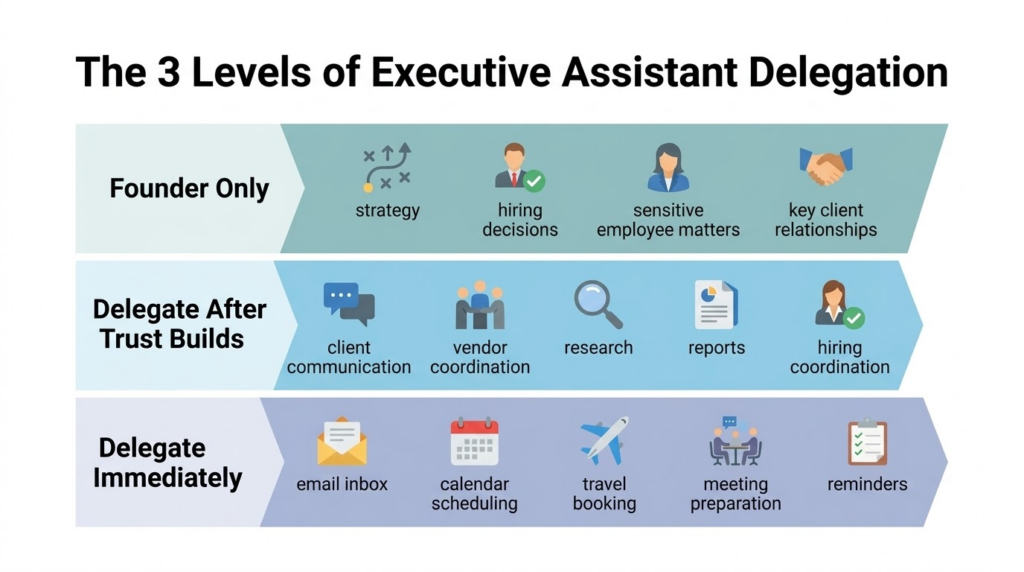
- Delegate tasks in 3 categories: immediately (inbox, calendar, travel), after trust builds (client follow-up, reports, research), and never (strategy, sensitive HR issues).
- Use daily standups or async updates for alignment, weekly meetings for priorities and feedback, and shared tools for visibility.
- Give clear, specific feedback; avoid silent correction. Use task comments, Loom videos, and process docs to communicate standards.
- Build trust through high-volume repeatable tasks first, then expand gradually. Visibility and proactive communication accelerate trust.
- In first 90 days: train on systems (month 1), expand delegation (month 2), aim for ownership and independence (month 3).
- Review performance monthly at first, then quarterly. Expand scope deliberately when core responsibilities are fully handled.
The mindset shift: your executive assistant multiplies your time
Strong founders treat their executive assistant as a partner in managing priorities, not a task executor who clears the inbox. The distinction matters because it changes how you delegate, what you explain, and how much context you share. A task executor needs instructions. A priority partner needs to understand where your time is most valuable so they can protect it.
Why delegation feels uncomfortable at first
Most founders built their company by doing everything themselves. They know how every process works because they built most of them. Handing work to someone else feels risky not because they doubt the assistant, but because they have no system for verifying that delegated work will meet their standard. The discomfort is usually a system problem, not a trust problem. Fixing the system removes the discomfort.
The real goal of EA management
The purpose of the relationship is straightforward. The assistant manages logistics, coordination, and recurring operational tasks so the founder can focus time and attention on decisions, leadership, and client work. Every task the assistant handles is a task that no longer competes for the founder’s attention. The management structure you build determines how much of that trade actually happens.
What strong EA partnerships look like
In a well-functioning EA relationship, the founder’s calendar is owned by the assistant and reflects actual priorities. Recurring workflows run without prompting. Meetings have preparation materials before they start. Follow-ups happen without the founder tracking them. The assistant is not doing more important work than the founder; they are doing the work that would otherwise fragment the founder’s day into small, low-value interruptions.
The three categories of delegation
Delegation works best when it is structured rather than reactive. Dumping tasks as they arise creates an inconsistent workload for the assistant and no clear mental model for the founder about what belongs in the EA’s lane. The three-category framework solves this.
Tasks to delegate immediately
These are the tasks to delegate to executive assistant from day one, before trust has been established through demonstrated performance. They are high-volume, lower-stakes, and have clear right and wrong answers:
- Inbox triage: sorting, flagging, categorizing, and drafting responses for routine correspondence.
- Calendar scheduling: booking, rescheduling, and managing conflicts across internal and external calendars.
- Travel coordination: researching options, booking flights and accommodation, and building itineraries.
- Meeting preparation: collecting agendas, distributing prep materials, and setting up recurring meetings.
- Follow-up reminders: tracking outstanding items and prompting the appropriate person when action is needed.
These tasks are delegable from day one because errors are visible, correctable, and low-cost. If the assistant books the wrong hotel, you catch it before departure. If a follow-up email goes out with a minor tone issue, you fix the template. The learning happens quickly because the feedback loop is short.
Tasks to delegate after trust builds
These tasks involve more judgment or carry higher stakes if done incorrectly. They typically shift to the assistant over months one and two once the founder can see how the assistant handles complexity:
- Client follow-ups: correspondence on behalf of the founder that touches active relationships.
- Vendor coordination: managing ongoing vendor relationships, tracking deliverables, and flagging issues.
- Report preparation: pulling data, compiling summaries, and formatting documents for review.
- Research projects: gathering background on prospects, competitors, or specific topics for founder decision-making.
- Hiring coordination: scheduling interviews, managing candidate communication, and maintaining hiring pipelines.
The transition point for each of these tasks is when you have enough visibility into how the assistant thinks to trust their judgment on matters that have external impact. That visibility comes from watching them handle the immediate-delegation tasks well over time.
Tasks that stay with the founder
These are not delegation opportunities regardless of how good the assistant is:
- Strategic planning and direction-setting decisions.
- Hiring decisions and final offer approvals.
- Sensitive employee matters including performance issues and terminations.
- Client relationships where the founder’s personal involvement is part of the value.
The assistant may support these areas by preparing materials, scheduling conversations, or tracking related tasks. The decisions themselves stay with the founder.
Industry-specific tasks your EA can take over
CPA firms during busy season
For CPA firm owners, the weekly check-in during tax season becomes a critical coordination point. Specific tasks the EA can own include client document reminders (tracking which clients have not yet submitted required materials and following up on a set schedule), tax appointment scheduling and rescheduling, extension reminders with appropriate lead time, and engagement letter tracking to confirm signatures before work begins.
These tasks share a common structure: they are deadline-driven, repeatable, and time-consuming for the CPA but procedural for the EA. Moving them to the assistant recovers hours per week during the period when the CPA’s time is most valuable.
HR and payroll firms
HR and payroll environments add a confidentiality layer to delegation decisions. Within appropriate scope, the EA can handle onboarding paperwork coordination for new client employees, payroll deadline reminders to client contacts, benefits documentation distribution during open enrollment periods, and scheduling for HR manager and client meetings. Tasks involving sensitive employee data, compensation decisions, or compliance determinations stay with the HR professional.
Founder operations support
Beyond industry-specific tasks, EAs can take significant operational load off founders across meeting preparation (pre-meeting briefings, relevant background, discussion questions), research summaries for decisions the founder needs to make, podcast or media guest coordination if relevant, and internal reporting compilation from tools the founder tracks but does not need to pull manually.
Communication systems that make EA management work
The most common reason EA relationships underperform is inconsistent communication. Without a regular rhythm, the assistant works from outdated priorities and the founder receives updates they did not ask for on timing that does not match their workflow.
The daily alignment method
Two approaches work well depending on communication preference. A five-minute daily standup meeting, either live or async via Loom, establishes what is in motion today, what is blocked, and what needs to change. An async daily update in Slack or a task management tool works for founders who prefer not to add a daily meeting but still want priority visibility. The goal in either case is one moment per day where the assistant and founder are looking at the same information and confirming the day is organized correctly.
The executive assistant weekly check-in
A weekly meeting keeps the broader priority picture aligned. The executive assistant weekly check-in structure typically covers upcoming priorities for the week ahead, any current blockers the assistant cannot resolve independently, delegation opportunities the assistant has identified, and feedback in both directions. Thirty minutes is usually enough. More than 45 minutes usually signals that the async communication structure during the week needs improvement.
Tools that keep work organized
The specific tools matter less than consistent use. A shared task board (Asana, ClickUp, Monday, Notion) where both founder and assistant track open items gives both parties visibility without requiring check-in meetings for every small update. A shared calendar where the EA has management access rather than just view access allows actual ownership rather than just awareness. Documented procedures in a shared drive give the EA a reference point when they are uncertain, which reduces interruptions to the founder and speeds up decisions.
How to give clear feedback to an offshore executive assistant
Feedback is where most EA relationships stall. The assistant produces work that is 80% right. The founder fixes the 20% silently and moves on. Nothing changes. The next piece of work has the same 20% problem.
Avoid the silent correction problem
When you quietly redo work instead of explaining what should change, you are not protecting the assistant from criticism. You are preventing them from improving. The assistant has no information about what was wrong, so they produce the same output next time. Over months, this creates a ceiling on what you can delegate because you have never communicated the standard you expect. Harvard Business Review’s research on executive time management consistently identifies unclear feedback as one of the primary reasons delegation relationships fail to mature.
Use clear feedback loops
Effective feedback for remote and offshore assistants takes three common forms. Task review comments in your shared task board are the simplest: note specifically what was correct, what needed to change, and what the revised approach should be. Short Loom recordings work well when the issue is easier to show than describe, particularly for software tasks or formatting questions. Written process updates, added to the SOP the assistant already follows, convert one-time feedback into a permanent standard that does not require repeating. The giving feedback to offshore EA framework covers how to structure each type and how frequently to use each in the early months of the relationship.
How trust develops between founders and executive assistants
Trust between a founder and an executive assistant is not a feeling. It is accumulated evidence that the assistant can be given a task, will complete it to the expected standard, and will surface problems proactively when something does not match expectations. Building that evidence base is a deliberate process.
Start with repeatable tasks
Inbox sorting, travel booking, and meeting scheduling provide the foundation because they are high-volume and have clear quality signals. When the assistant handles a hundred calendar requests correctly, you have visible evidence about their attention to detail, judgment about priorities, and communication quality. That evidence base makes the next delegation decision easier.
Expand responsibility gradually
Once the foundation is established, project coordination, client communication, and internal reporting create the next layer of evidence. Each new category adds a data point about how the assistant handles complexity, ambiguity, and external relationships. The building trust with remote EA framework describes a specific visibility structure for offshore assistants that makes the trust-building process faster by keeping the founder informed during the expansion periods without creating a supervision burden.
The visibility principle
Trust develops faster when work is visible. An assistant who documents their work in a shared tool, provides status updates without prompting, and flags issues before they escalate gives the founder ongoing evidence of their judgment and reliability. An assistant who completes tasks silently and only surfaces problems when they become urgent provides no visibility between assignment and completion, which requires the founder to trust without evidence.
Your first 90 days managing an executive assistant
The full executive assistant 30-60-90 plan covers each phase in detail. The structure below provides the framework.
Month 1: training and observation
Month one is about systems, tools, and workflow visibility. The assistant learns your platforms, your communication preferences, and your standard procedures. You observe how they handle the immediate-delegation task set and identify where SOPs need to be written or clarified. The goal at the end of month one is a fully functioning assistant on the core task set, not a fully autonomous operator.
Month 2: delegation expansion
Month two shifts recurring tasks from the founder to the assistant. Tasks that you handled during month one because they were new to the assistant now transfer. You are still reviewing output but less frequently. The assistant begins flagging delegation opportunities they have identified rather than waiting to be assigned.
Month 3: ownership and independence
By month three, the assistant is running documented workflows without daily check-ins. The weekly alignment meeting is about expansion and improvement rather than basic coordination. The founder’s time investment in management has decreased because the systems are working.
Performance reviews for executive assistants
Monthly performance checkpoints
Monthly reviews in the first quarter keep the relationship calibrated. Review task accuracy (are completed tasks meeting the expected standard without requiring correction?), communication quality (are updates timely, clear, and appropriately scoped?), and responsiveness (are requests acknowledged and completed within the agreed timeframes?). These three areas cover the operational core of the EA role. Forbes has noted in multiple executive productivity pieces that administrative relationships that include structured performance checkpoints in the first 90 days demonstrate significantly higher long-term output than those that do not.
Quarterly reviews
Quarterly reviews address the longer arc of the relationship: which parts of the role have developed well, where additional training or documentation would improve performance, and what expansion of responsibilities makes sense given the current performance level. The International Association of Administrative Professionals (IAAP) recommends quarterly competency reviews as part of professional development for EA roles, covering task mastery, communication, and judgment development.
Signs it is time to expand your EA’s role
The signals that the current scope is fully managed and expansion is appropriate are operational: the inbox is consistently sorted and handled to the expected standard without correction, the calendar reflects actual priorities and runs without founder involvement, and recurring workflows are documented and running independently. When those three conditions are met, the EA has capacity and demonstrated judgment for the next category.
Expanded executive assistant skills at this stage often include project coordination (tracking multi-step projects with external dependencies), client communication (handling routine correspondence with active relationships), and operations support (owning reporting workflows and internal tracking systems). The expansion works best when it is deliberate: one new category at a time, with clear SOPs, and a defined review period before the next expansion.
Hiring an executive assistant does not automatically reduce a founder’s workload. The management structure does. When delegation rules are clear, communication has a consistent rhythm, and feedback creates actual improvement over time, the assistant becomes a central operator in the business rather than a peripheral helper waiting for direction.
If you want a practical starting point, the OutsourcedScale team can walk through the delegation framework, communication systems, and onboarding structure with you directly. If you are still deciding whether to hire independently or work with a provider who handles the recruitment and training. Why Outsourced Scale is the top choice covers what that comparison looks like. Schedule a conversation to talk through what your first 90 days should look like.
FAQs about HR Companies Executive Assistant Skills
Executive assistants typically manage email and calendar, travel arrangements, meeting preparation, follow-up coordination, and recurring operational workflows; the specific task set expands as the assistant demonstrates consistent performance in the core areas.
A weekly alignment meeting of 30 minutes covers priorities, blockers, and feedback; a brief daily async update in Slack or a task board keeps day-to-day coordination on track without adding meeting overhead.
Start with repeatable tasks that have clear quality standards, document the workflow in an SOP, and expand the scope gradually as the assistant demonstrates accuracy and judgment in the initial task set.
Trust develops through consistent communication, visible task tracking in a shared tool, clear and specific feedback when work needs improvement, and deliberate expansion of responsibility when performance evidence supports it.
Strategic planning decisions, hiring decisions, sensitive employee matters, and any work where the founder’s direct judgment is part of the value should remain with the founder regardless of how capable the assistant is.