Most EA job postings list degree requirements. Most successful EAs built their careers without one. Here’s what actually predicts performance. The direct answer: no, a college degree is not required to become an effective virtual executive assistant, and requiring one in your job posting will filter out a large portion of qualified candidates without improving your hiring outcomes. That said, there are specific situations where a degree adds value, and understanding where the line falls helps you write a better job posting and make a better hire.
This article covers what the education data actually shows, when degrees matter, what matters more, certifications worth considering, and how to evaluate candidates without relying on credentials. If you are writing your first executive assistant job description, this gives you a research-backed answer to the degree question before you post.
Key Takeaways
- 39% of working EAs don’t have bachelor’s degrees; skills and experience often matter more than formal education.
- Degrees add value for specialized industries (legal, medical, finance), senior strategic roles, and certain career advancement paths.
- Skills that predict EA performance: organization, communication, judgment under pressure – none require degrees to develop.
- Relevant experience in admin, customer service, event planning, or project coordination is transferable to EA roles.
- CAP, PACE, and Microsoft Office Specialist certifications can demonstrate competence, but don’t guarantee employer recognition.
- Assess candidates with skill-based exercises (writing, scheduling scenarios, research tasks) rather than degree requirements alone.
What the data actually shows
EA education statistics
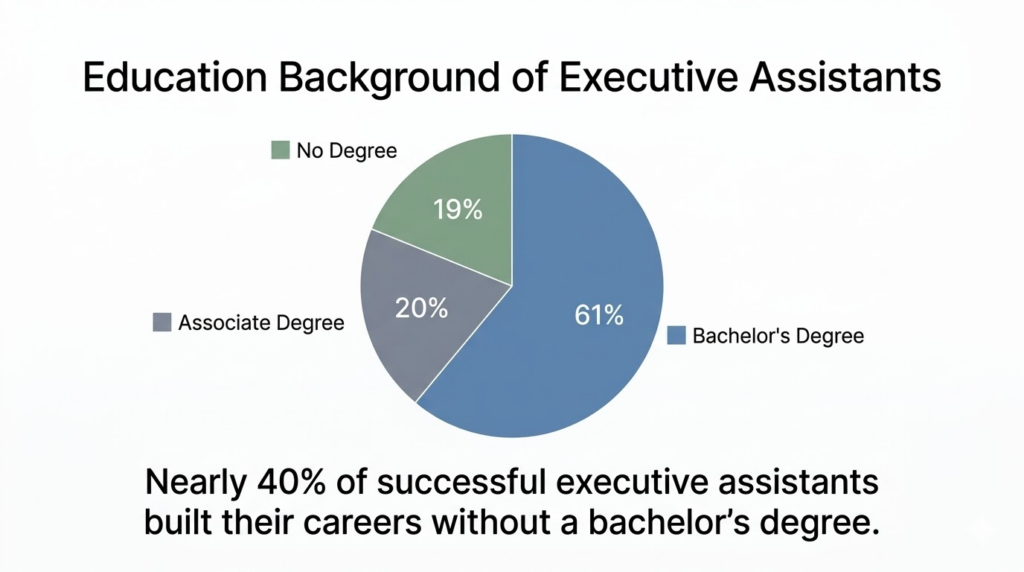
Zippia’s analysis of 160,321 EA resumes found that 61% of executive assistants hold bachelor’s degrees and 20% hold associate degrees. That means nearly 40% of the people doing this work well did not complete a four-year degree program. The Bureau of Labor Statistics confirms that a bachelor’s degree is not typically required for secretaries and administrative assistants. U.S. News ranks EA as one of the top three highest-paying jobs available without a degree.
The gap between what job postings require and what successful hires actually have is worth sitting with. If a significant portion of the working EA population built strong careers without degrees, using a degree as a primary filter means regularly passing over capable people in exchange for a credential that does not predict the capability you actually need.
What research says about skills versus degrees
McKinsey research on hiring practices found that skills-based hiring is five times more predictive of job performance than education-based hiring, and two times more predictive than work experience. Harvard Business Review data shows employees hired based on demonstrated skills have 25% higher performance ratings and 40% lower turnover than credential-matched hires. SHRM research indicates that employees hired on skills stay nine months longer on average.
Schmidt and Hunter’s research on hiring validity, updated through 2016, consistently shows education as a weak predictor of job performance compared to work samples, cognitive ability assessments, and structured interviews. These findings hold across industries. There is no strong evidence that EA work is an exception.
When a degree actually adds value
Degrees are not irrelevant. They add genuine value in specific contexts, and being honest about those contexts is more useful than blanket dismissal.
Specialized industry environments
Legal settings where paralegal background is relevant, medical and healthcare administration roles with compliance requirements, and financial services positions requiring demonstrated business acumen all represent contexts where formal education can map to actual job requirements. If your EA will be navigating industry-specific terminology, regulatory documentation, or client-facing situations where credentials carry professional weight, a degree or formal training in that field has practical value.
Senior-level and C-suite adjacent roles
EAs supporting senior executives at larger organizations, Chief of Staff roles, and positions that include strategic coordination alongside administrative support are contexts where business fundamentals, developed through formal education or equivalent experience, matter more than in task-focused roles. If the role involves participating in planning discussions, managing other staff, or representing the executive in substantive ways, the reasoning skills developed through formal education can be relevant.
Career advancement paths
Some CAP certification paths require an associate’s or bachelor’s degree plus experience. MBA programs are relevant for EAs pursuing Chief of Staff or operational leadership tracks. For EAs with long-term career goals in business operations, a degree provides a foundation worth having. For founders evaluating candidates, this matters less than whether the candidate can do the work in front of them right now.
What matters more than a degree
Demonstrated skills
The executive assistant skills that actually predict performance are organizational, communicative, and judgment-based: managing competing priorities without dropping things, writing clearly under time pressure, handling confidential information with discretion, anticipating what needs to happen before being asked, and making small decisions independently rather than escalating everything.
None of these skills require a degree to develop, and none of them are reliably predicted by whether someone went to college. They are visible in how a candidate handles a writing exercise, how they describe a scheduling conflict they navigated, and what they do when given an ambiguous task with limited direction.
Relevant experience
Administrative or clerical roles, customer service work, event planning and coordination, project management support, and any role requiring multitasking, prioritization, and communication under pressure all build the foundational skills EA work requires. The experience does not need to carry the title “executive assistant” to be relevant. A coordinator who managed logistics for 50-person events, a customer service representative who handled complex escalations, and an office manager who ran operations for a small team all have transferable capability worth evaluating.
Professional certifications
Three certifications are relevant to EA hiring and worth understanding for both founders and candidates.
The CAP (Certified Administrative Professional), offered by the International Association of Administrative Professionals, covers organizational communication, project management, and technology proficiency. It requires either a bachelor’s degree plus two years of experience, or an associate’s degree plus three years. Cost ranges from $375 to $575 depending on membership status, and the exam is offered in spring and fall only.
The PACE (Professional Administrative Certification of Excellence), offered by the American Society of Administrative Professionals, covers communication, technology, project management, and leadership across four online modules. It costs $375, has no degree requirement, and is self-paced. For candidates without degrees who want to demonstrate commitment and competence, PACE is the more accessible option.
Microsoft Office Specialist certification validates proficiency in specific Microsoft applications with no prerequisites. For roles where Excel, Word, or PowerPoint proficiency matters, this is a concrete, verifiable signal.
Honest note on all three: real-world feedback from EA communities suggests that not all employers recognize these certifications or offer salary increases for holding them. They demonstrate commitment and can strengthen a resume, but they are not guarantees of competitive advantage. Candidates pursuing them should treat the skills development as the primary value rather than the credential itself.
How to evaluate candidates without relying on degree requirements
Skill-based assessment methods
The most reliable way to assess EA capability is to ask candidates to do work that resembles the actual job. An executive assistant skills assessment built around the specific tasks you need covered gives you more signal than a resume review.
Useful assessment components:
- Written communication exercise: give a realistic email scenario and evaluate the response for clarity, tone, and accuracy.
- Calendar management scenario: present a scheduling conflict with competing constraints and observe how the candidate navigates it.
- Software proficiency check: a brief live exercise in the tools central to your workflow takes less than thirty minutes and verifies claimed skill levels.
- Research task: ask for a structured summary of a topic within a defined timeframe and evaluate the output for usability, not just completeness.
Interview questions that reveal capability
Structured interview questions focused on specific situations surface judgment and experience more reliably than questions about credentials. Using your executive assistant interview questions framework, focus on:
- “Walk me through how you would handle a situation where two urgent requests from different stakeholders arrive at the same time.”
- “Describe a time you anticipated a problem before it became urgent. What did you notice and what did you do?”
- “How do you decide what to handle independently versus what to escalate?”
The specificity and detail in the answers tells you more than the educational background on the resume.
What to put in your job posting
For most EA roles at founder-led service businesses, degree requirements belong in the “preferred” category at most, not in the “required” section. Placing a degree in the required list filters out candidates who would perform well and does not meaningfully improve the candidate pool you end up with.
A stronger approach is to list the skills and experience you actually need: two or more years of administrative experience in a relevant environment, strong written communication, proficiency in specific tools, organizational discipline, and discretion with sensitive information. These criteria attract candidates who can do the work rather than candidates who match a credential checklist.
The full how to hire a virtual executive assistant process covers sourcing, assessment, and onboarding once you have your requirements clear.
See the skill-based criteria OutsourcedScale uses instead of degree requirements. Schedule a conversation to learn how our pre-vetted EAs are evaluated before they reach you.
FAQs about executive assistant education background
The minimum requirement for entry-level positions is typically a high school diploma; many employers prefer candidates with associate’s or bachelor’s degrees, but Zippia’s data shows 39% of working EAs do not hold bachelor’s degrees, and skills and experience often matter more than formal education.
Yes, though entry-level administrative roles like receptionist, office assistant, or data entry provide the most direct path; transferable skills from customer service, event planning, or coordination roles also count, and certifications like PACE can help demonstrate competence without prior EA experience.
CAP from IAAP and PACE from ASAP are the most recognized options; CAP requires a degree plus experience while PACE has no degree requirement, and Microsoft Office Specialist certification demonstrates technical proficiency with no prerequisites, though real-world salary impact varies by employer.
McKinsey research found skills-based hiring is five times more predictive of job performance than education-based hiring; for EA roles specifically, demonstrated organizational, communication, and judgment skills consistently matter more than where or whether someone attended college.